Wednesday, June 15, 2011

A guide to the lunar eclipse for beginners

Today is a special day with us together with the moon.
A glowing moon that hides behind the earth’s jacket, a familiar story we have all heard.
For most, childhood is far behind and confusion abound. Does the sky burn bright or is it a diamond ring in the sky, are amidst so many questions that heckle the mind.
In an attempt to experience how it happens – here’s what those science nerds have to say:
First, you cannot have a lunar eclipse without a full moon at night, and unlike its alter ego – the solar eclipse, you can view the event from several spots on earth. So, if you’re planning to travel, make sure you hit Africa, Central Asia, South America, Europe, Australia or the Philippines – or just sit back at home in India.
Lucky for us, we will be witnessing what is called a total lunar eclipse. A total eclipse sees an inflamed moon, crimson-hued in the darkest of skies eclipses could have. For those who value their sleep, the eclipse lasts for almost three and a half hours. The eclipse shall commence with a dimming disappearance of the moon, also called the partial phase.
When it’s time, the moon shall shy away behind the triumphant shadow of the earth. Blocking out the light of the sun, the moon will slowly be eschewed till it reappears with its fiery facet during the total phase. Playing hide and seek once again, the body disappears to resurface in its placid tone of grey thereby ending the eclipse.
Perplexities often arise on understanding how the moon changes its colour when the sun is blocked out. It is merely a reflection of the earth from the residue rays of the sun that filter through. The ash and dust in the atmosphere determine the shade that the moon would be adorning. Experts are excited this year, as they are hoping to see what effect the ash cloud over Europe would have on the eclipse.
For those who wish to capture the moment, your can take a long look with your bare eyes. Unlike solar eclipses, you wouldn’t need those shades! And for them clickers, you needn’t protect your camera with filters – the same logic works here.
So fuel-up with some energy drink or a cup or cups of coffee and keep those camera ready. Total lunar eclipses can be quite a sight, quite a rare one in fact.
So, from 22:23pm Abu Dhabi time to 23:23 don’t forget to eat your way through superstition, and celebrate the moon in full bloom.

ECLIPSE TONIGHT

Those who wants to view the eclipse tonight. You can go to corniche area, bring your friends and family, have a warm drinks, feel the cold breeze of air and enjoy watching the moon as the eclipse arise.

ECLIPSE TONIGHT JUNE 15. 2011

T'WAS NIGHT BEFORE ECLIPSE


Photos taken on the night of June 14.... eclipse will be on June 15...

Monday, June 13, 2011

Physicists hit on mathematical description of superfluid dynamics

Such superfluids are found in neutron stars, which rotate between one and 1,000 times a second.

By University of Washington, Seattle — Published: June 9, 2011
von-Karman-vortices-superfl
A 2001 photo from the space shuttle shows a phenomenon called von Karman vortices in clouds downwind from Rashiri Island in the northern Sea of Japan. The vortices are similar to those that form in superfluids.
Photo by NASA
It has been 100 years since the discovery of superconductivity, a state achieved when mercury was cooled, with the help of liquid helium, to nearly the coldest temperature achievable to form a superfluid that provides no resistance to electrons as they flow through it.

During that century, scientists have struggled to find a precise mathematical explanation of why and how this strange fluid behaves as it does. Liquid helium-4 itself becomes a superfluid when cooled to within a few degrees of absolute zero on the Kelvin scale (minus 273 Celsius or minus 460 Fahrenheit), and the resulting lack of viscosity allows it to seem to defy gravity, flowing up and over the sides of a container.

Now a team led by a University of Washington physicist, using the most powerful supercomputer available for open science, has devised a theoretical framework that explains the real-time behavior of superfluids that are made of fermions -- subatomic particles such as electrons, protons and neutrons that are basic building blocks of nature.

Such superfluids are found in neutron stars, which rotate between one and 1,000 times a second. These stars, also called pulsars, have 50 percent greater mass than the Sun but are packed so densely that one can occupy an area only about the size of a city such as Seattle, said Aurel Bulgac, a UW physics professor and lead author of a paper in the June 10 edition of Science that details the work.

As a neutron star rotates, the superfluid on the surface behaves quite differently than a liquid would on the surface of the Earth. As the rotational speed increases the fluid opens a series of small vortices. As the vortices assemble into triangular patterns, the triangles build a lattice structure within the superfluid.

“When you reach the correct speed, you’ll create one vortex in the middle,” Bulgac said. “And as you increase the speed, you will increase the number of vortices. But it always occurs in steps.”

Similar behavior can be recreated in a laboratory using a vacuum chamber and a laser beam to create a high-intensity electrical field that will cool a small sample, perhaps 1 million atoms, to temperatures near absolute zero. A “laser spoon” then can stir the superfluid fast enough to create vortices.

In trying to understand the odd behavior, scientists have attempted to devise descriptive equations, as they might to describe the swirling action in a cup of coffee as it is stirred, Bulgac said. But to describe the action in a superfluid made of fermions, a nearly limitless number of equations is needed. Each describes what happens if just one variable -- such as velocity, temperature or density -- is changed. Because the variables are linked, if one changes others will change as well.

The challenge, Bulgac said, was to formulate the proper mathematical problem and then find a computer that could work through the problem as the number of variable changes reached 1 trillion or more. To reach its solution, the team in the last year used the JaguarPF computer at Oak Ridge National Laboratory in Tennessee, one of the largest supercomputers in the world, for the equivalent of 70 million hours, which would require almost 8,000 years on a single-core personal computer (JaguarPF has nearly a quarter-million cores).

“This tells you the complexity of these calculations and how difficult this is,” he said.

The researchers also found through their calculations that by increasing the speed at which the fluid was stirred, eventually it would lose its superfluid properties -- though not as soon as had been previously hypothesized.

The work means that researchers can “to some extent” study the properties of a neutron star using computer simulations, Bulgac said.

It also opens new directions of research in cold-atom physics.

“This is a pretty major step forward in studying these dynamic processes,” he said.

Thursday, June 9, 2011

MASSIVE SOLAR ERUPTION

Morning of June 7th around 06:41 UT, magnetic fields above sunspot complex 1226-1227 became unstable and erupted. The blast produced an M2-class solar flare, an S1-class radiation storm, and a massive CME. A recording of the blastfrom NASA's Solar Dynamics Observatory ranks as one of the most beautiful and dramatic movies of the SDO era. This video of the massive solar flare and ensuing solar prominence should reveal all. “I’ve never seen material released like this before, such a huge amount that falls back down in such a spectacular way,” says Goddard Spaceflight Center’s Dr. C. Alex Young in their video, in which he does a thorough job of explaining exactly what you’re looking at. “It looks like someone just kicked a giant clod of dirt into the air and it fell back down.”

Wednesday, June 8, 2011

LUNAR ECLIPSE IN FEW DAYS


On June 15th, a total lunar eclipse will take place,
visible in India, Middle-East and west-Africa. It will be partly visible in
Europa, Australia and South America. This total lunar eclipse is special
because the Moon passes almost exactly in front of the center of the Earth's
shadow. The last lunar eclipse closer to the center of the earth's shadow was on July 16, 2000. The next central total lunar eclipse will be on July 27, 2018.

Monday, June 6, 2011

ABU DHABI AT NIGHT 4-6-11

Emirates Palace hotel a seven star hotel in Abu Dhabi

silhouetted mosque

 peeking moon

 overlooking construction site

 marina mall in full light

 head light

glowing mosque

Friday, June 3, 2011

GALAXY COLLECTIONS


Abu Dhabi 4 years back.

Way back years in defending Pluto as one of the solar system's planet


Get an interview with the issue of demoting Pluto as one of the nine planet in the solar system.

Thursday, June 2, 2011

ECLIPSE OF THE MIDNIGHT SUN

 A solar eclipse at midnight? It's not only possible, it actually happened last night. On June 1st, the new Moon passed in front of the midnight sun above the Arctic circle, producing a partial eclipse of exquisite beauty. Bernt Olsen photographed the event from Sommarøy, Tromsø, Norway:
"A rain shower threatened to spoil the show, but just before midnight the clouds parted and I got a fairly clear shot of the eclipse," says Olsen. "I'm glad I did, because we won't experience an eclipse like this again for 73 years."
Until then, browse the links for more eclipse shots: from Kulkova Svetlana of Bratsk, Russia; from Travis Stagg of Fairbanks Alaska; from B.Art Braafhart of Sallatunturi, Finnish Lapland; from Thomas Hagen of Tromsø, Norway; from Johan Kero of Bergfors, Kiruna, Sweden; from Joerg Schoppmeyer of Akureyri, Iceland.

Credit: spaceweather.com

Wednesday, June 1, 2011

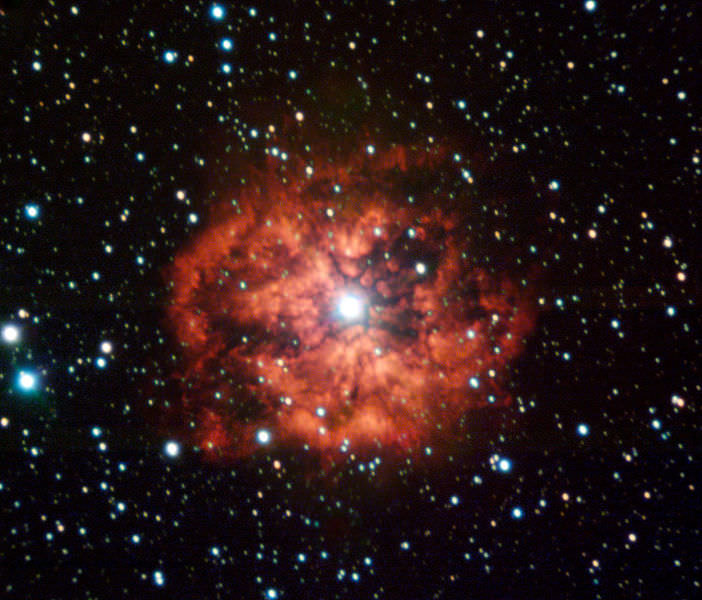
M1-67 NEBULA


M1-67 is the youngest wind-nebula around a Wolf-Rayet star, called WR124, in our Galaxy. Credit: ESO

In 1867, astronomers using the 40 cm Foucault telescope at the Paris Observatory, discovered three stars in the constellation Cygnus (now designated HD191765, HD192103 and HD192641), that displayed broad emission bands on an otherwise continuous spectrum. The astronomers' names were Charles Wolf and Georges Rayet, and thus this category of stars became named Wolf–Rayet (WR) stars.[3] Most stars display absorption bands in the spectrum, as a result of overlaying elements absorbing light energy at specific frequencies. The number of stars with emission lines is quite low, so these were clearly unusual objects.
The nature of the emission bands in the spectra of a Wolf–Rayet star remained a mystery for several decades. Edward C. Pickering theorized that the lines were caused by an unusual state ofhydrogen, and it was found that this "Pickering series" of lines followed a pattern similar to theBalmer series, when half-integral quantum numbers were substituted. It was later shown that the lines resulted from the presence of helium; a gas that was discovered in 1868.
By 1929, the width of the emission bands was being attributed to the Doppler effect, and hence that the gas surrounding these stars must be moving with velocities of 300–2400 km/s along the line of sight. The conclusion was that a Wolf–Rayet star is continually ejecting gas into space, producing an expanding envelope of nebulous gas. The force ejecting the gas at the high velocities observed is radiation pressure.
In addition to helium, emission lines of carbon, oxygen and nitrogen were identified in the spectra of Wolf–Rayet stars. In 1938, the International Astronomical Union classified the spectra of Wolf–Rayet stars into types WN and WC, depending on whether the spectrum was dominated by lines of nitrogen or carbon-oxygen respectively.

File:Wolf rayet2.jpg
Hubble Space Telescope image of nebula M1-67 around Wolf–Rayet star WR 124.

Wolf–Rayet stars (often referred to as WR stars) are evolved, massive stars (over 20 solar masses initially), which are losing mass rapidly by means of a very strong stellar wind, with speeds up to 2000 km/s. While our own Sun loses approximately 10−14 solar masses every year, Wolf–Rayet stars typically lose 10−5 solar masses a year.
Wolf–Rayet stars are very hot, with surface temperatures in the range of 25,000 K to 50,000 K.


credit: wikipedia 

Sunday, May 29, 2011

Edge of the Universe

Australian Student Astronomer Finds Universe's Missing Mass


Science - Blue sphere in space


An Australian student at Monash University has made a breakthrough in the field of astrophysics, discovering what has until now been described as the Universe’s ‘missing mass.’ Amelia Fraser-McKelvie, working as a member of a team at the Monash School of Physics, conducted a targeted X-ray search for the matter and within just three months found it – or at least some of it.

What makes the discovery all the more noteworthy is the fact that Fraser-McKelvie is not a career researcher, or even studying at a postgraduate level. She is a 22-year-old undergraduate Aerospace Engineering/Science student who pinpointed the missing mass during a summer scholarship, working with two astrophysicists at the School of Physics, Dr. Kevin Pimbblet and Dr. Jasmina Lazendic-Galloway.

The School of Physics put out a call for students interested in a six-week paid astrophysics research internship during a recent vacation period, and chose Ms Fraser-McKelvie from a large number of applicants. Dr. Pimbblet, lecturer in the School of Physics put the magnitude of the discovery in context by explaining that scientists had been hunting for the Universe’s missing mass for decades.

"We've been looking for this ordinary matter for a couple of decades," said Dr. Pimbblett. "It's been published in one of the most prestigious journals in the world, so astronomers all over the world will be able to read this article." Predicting that the discovery may change the way telescopes are built, the astronomer said "We will be using this as part of the science drivers for some telescopes that are on the design board, that are being built right at this moment in time," he said.

Not since the work of Fritz Zwicky has the astronomy world been so excited about the missing mass of the Universe. Zwicky's evidence came from observing the orbital velocities of galaxies in clusters, rotational speeds, and gravitational lensing of background objects. Fraser-McKelvie's breakthrough in the world of astrophysics may verify Zwicky's findings. Born in Switzerland, Zwicky spend most of career at California Technological University, where he made advances in both observational and theoretical astronomy.
“It was thought from a theoretical viewpoint that there should be about double the amount of matter in the local Universe compared to what was observed.  It was predicted that the majority of this missing mass should be located in large-scale cosmic structures called filaments - a bit like thick shoelaces,” said Dr. Pimbblet.

Astrophysicists also predicted that the mass would be low in density, but high in temperature - approximately one million degrees Celsius. This meant that, in theory, the matter should have been observable at X-ray wavelengths. Amelia Fraser-McKelvie’s discovery has proved that prediction correct.
Fraser-McKelvie said the ‘Eureka moment’ came when Dr. Lazendic-Galloway closely examined the data they had collected.  “Using her expert knowledge in the X-ray astronomy field, Jasmina reanalysed our results to find that we had in fact detected the filaments in our data, where previously we believed we had not.” She added, "I feel really lucky."

X-ray observations provide important information about physical properties of large-scale structures, which can help astrophysicists better understand their true nature. Until now, they had been making deductions based only on numerical models, so the discovery is a huge step forward in determining what amount of mass is actually contained within filaments.
Still a year away from undertaking her Honors year (which she will complete under the supervision of Dr. Pimbblet), Fraser-McKelvie is being hailed as one of Australia’s most exciting young students.  Her work has been published in one of the world’s oldest and most prestigious scientific journals, the Monthly Notices of the Royal Astronomical Society.

“Being a published author is very exciting for me, and something I could never have achieved without the help of both Kevin and Jasmina. Their passion and commitment for this project ensured the great result and I am very thankful to them for all the help they have given me and time they have invested,” said Fraser-McKelvie.
Dr. Pimbblet said that Fraser-McKelvie is very talented student who excelled in performing the breakthrough research. “She has managed to get a refereed publication accepted by one of the highest ranking astronomy journals in the world as a result of her endeavours.  I cannot underscore enough what a terrific achievement this is. We will use this research as a science driver for future telescopes that are being planned, such as the Australian Square Kilometre Array Pathfinder, which is being built in outback Western Australian.” The paper can be found at the Cornell University website.http://arxiv.org/abs/1104.0711

Saturday, May 28, 2011

Black Holes Spin Faster and Faster


Two UK astronomers have found that the giant black holes in the center of galaxies are on average spinning faster than at any time in the history of the Universe. Dr. Alejo Martinez-Sansigre of the University of Portsmouth and Prof. Steve Rawlings of the University of Oxford made the new discovery by using radio, optical and X-ray data. They publish their findings in the journal Monthly Notices of the Royal Astronomical Society.

There is strong evidence that every galaxy has a black hole in its center. These black holes have masses of between a million and a billion Suns and so are referred to as 'supermassive'. They cannot be seen directly, but material swirls around the black hole in a so-called accretion disk before its final demise. That material can become very hot and emit radiation including X-rays that can be detected by space-based telescopes whilst associated radio emission can be detected by telescopes on the ground.

As well as radiation, twin jets are often associated with black holes and their accretion disks. There are many factors that can cause these jets to be produced, but the spin of the supermassive black hole is believed to be important. However, there are conflicting predictions about how the spins of the black holes should be evolving and until now this evolution was not well understood.

Dr. Martinez-Sansigre and Professor Rawlings compared theoretical models of spinning black holes with radio, optical and X-ray observations made using a variety of instruments and found that the theories can explain very well the population of supermassive black holes with jets.

Using the radio observations, the two astronomers were able to sample the population of black holes, deducing the spread of the power of the jets. By estimating how they acquire material (the accretion process) the two scientists could then infer how quickly these objects are spinning.

The observations also give information on how the spins of supermassive black holes have evolved. In the past, when the Universe was half its the present size, practically all of the supermassive black holes had very low spins, whereas nowadays a fraction of them have very high spins. So on average, supermassive black holes are spinning faster than ever before.

This is the first time that the evolution of the spin of the supermassive black holes has been constrained, and it suggests that those supermassive black holes that grow by swallowing matter will barely spin, while those that merge with other black holes will be left spinning rapidly.

Commenting on the new results, Dr. Martinez-Sansigre said: "The spin of black holes can tell you a lot about how they formed. Our results suggest that in recent times a large fraction of the most massive black holes have somehow spun up. A likely explanation is that they have merged with other black holes of similar mass, which is a truly spectacular event, and the end product of this merger is a faster spinning black hole."

Professor Rawlings adds: "Later this decade we hope to test our idea that these supermassive black holes have been set spinning relatively recently. Black hole mergers cause predictable distortions in space and time -- so-called gravitational waves. With so many collisions, we expect there to be a cosmic background of gravitational waves, something that will change the timing of the pulses of radio waves that we detect from the remnants of massive stars known as pulsars.

"If we are right, this timing change should be picked up by the Square Kilometre Array, the giant radio observatory due to start operating in 2019."

Science Contacts:
Dr. Alejo Martinez-Sansigre
University of Portsmouth
+44 (0)23 9284 5146; cell: +44 (0)755 297 9018
alejo.martinez-sansigre@port.ac.uk

Professor Steve Rawlings
University of Oxford
+44 (0)1865 273352
sr@astro.ox.ac.uk

Thursday, May 26, 2011

ARTIST IMPRESSION OF KEPLER-10B


the smallest exoplanet that was announced last January 2011, the picture above is an artist impression of Kepler-10b. Picture credited from NASA.