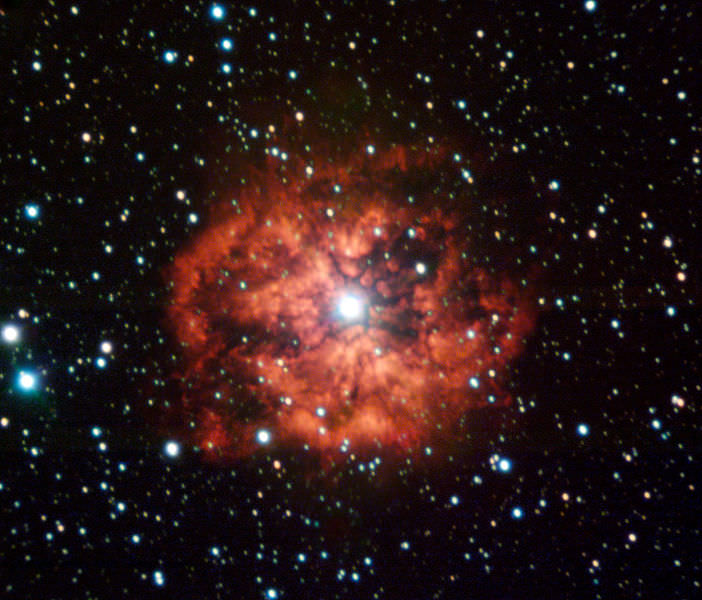
M1-67 is the youngest wind-nebula around a Wolf-Rayet star, called WR124, in our Galaxy. Credit: ESO
In 1867, astronomers using the 40 cm Foucault telescope at the Paris Observatory, discovered three stars in the constellation Cygnus (now designated HD191765, HD192103 and HD192641), that displayed broad emission bands on an otherwise continuous spectrum. The astronomers' names were Charles Wolf and Georges Rayet, and thus this category of stars became named Wolf–Rayet (WR) stars.[3] Most stars display absorption bands in the spectrum, as a result of overlaying elements absorbing light energy at specific frequencies. The number of stars with emission lines is quite low, so these were clearly unusual objects.
The nature of the emission bands in the spectra of a Wolf–Rayet star remained a mystery for several decades. Edward C. Pickering theorized that the lines were caused by an unusual state ofhydrogen, and it was found that this "Pickering series" of lines followed a pattern similar to theBalmer series, when half-integral quantum numbers were substituted. It was later shown that the lines resulted from the presence of helium; a gas that was discovered in 1868.
By 1929, the width of the emission bands was being attributed to the Doppler effect, and hence that the gas surrounding these stars must be moving with velocities of 300–2400 km/s along the line of sight. The conclusion was that a Wolf–Rayet star is continually ejecting gas into space, producing an expanding envelope of nebulous gas. The force ejecting the gas at the high velocities observed is radiation pressure.
In addition to helium, emission lines of carbon, oxygen and nitrogen were identified in the spectra of Wolf–Rayet stars. In 1938, the International Astronomical Union classified the spectra of Wolf–Rayet stars into types WN and WC, depending on whether the spectrum was dominated by lines of nitrogen or carbon-oxygen respectively.

Hubble Space Telescope image of nebula M1-67 around Wolf–Rayet star WR 124.
Wolf–Rayet stars (often referred to as WR stars) are evolved, massive stars (over 20 solar masses initially), which are losing mass rapidly by means of a very strong stellar wind, with speeds up to 2000 km/s. While our own Sun loses approximately 10−14 solar masses every year, Wolf–Rayet stars typically lose 10−5 solar masses a year.
Wolf–Rayet stars are very hot, with surface temperatures in the range of 25,000 K to 50,000 K.
credit: wikipedia


No comments:
Post a Comment