Sunday, May 29, 2011

Edge of the Universe

Australian Student Astronomer Finds Universe's Missing Mass


Science - Blue sphere in space


An Australian student at Monash University has made a breakthrough in the field of astrophysics, discovering what has until now been described as the Universe’s ‘missing mass.’ Amelia Fraser-McKelvie, working as a member of a team at the Monash School of Physics, conducted a targeted X-ray search for the matter and within just three months found it – or at least some of it.

What makes the discovery all the more noteworthy is the fact that Fraser-McKelvie is not a career researcher, or even studying at a postgraduate level. She is a 22-year-old undergraduate Aerospace Engineering/Science student who pinpointed the missing mass during a summer scholarship, working with two astrophysicists at the School of Physics, Dr. Kevin Pimbblet and Dr. Jasmina Lazendic-Galloway.

The School of Physics put out a call for students interested in a six-week paid astrophysics research internship during a recent vacation period, and chose Ms Fraser-McKelvie from a large number of applicants. Dr. Pimbblet, lecturer in the School of Physics put the magnitude of the discovery in context by explaining that scientists had been hunting for the Universe’s missing mass for decades.

"We've been looking for this ordinary matter for a couple of decades," said Dr. Pimbblett. "It's been published in one of the most prestigious journals in the world, so astronomers all over the world will be able to read this article." Predicting that the discovery may change the way telescopes are built, the astronomer said "We will be using this as part of the science drivers for some telescopes that are on the design board, that are being built right at this moment in time," he said.

Not since the work of Fritz Zwicky has the astronomy world been so excited about the missing mass of the Universe. Zwicky's evidence came from observing the orbital velocities of galaxies in clusters, rotational speeds, and gravitational lensing of background objects. Fraser-McKelvie's breakthrough in the world of astrophysics may verify Zwicky's findings. Born in Switzerland, Zwicky spend most of career at California Technological University, where he made advances in both observational and theoretical astronomy.
“It was thought from a theoretical viewpoint that there should be about double the amount of matter in the local Universe compared to what was observed.  It was predicted that the majority of this missing mass should be located in large-scale cosmic structures called filaments - a bit like thick shoelaces,” said Dr. Pimbblet.

Astrophysicists also predicted that the mass would be low in density, but high in temperature - approximately one million degrees Celsius. This meant that, in theory, the matter should have been observable at X-ray wavelengths. Amelia Fraser-McKelvie’s discovery has proved that prediction correct.
Fraser-McKelvie said the ‘Eureka moment’ came when Dr. Lazendic-Galloway closely examined the data they had collected.  “Using her expert knowledge in the X-ray astronomy field, Jasmina reanalysed our results to find that we had in fact detected the filaments in our data, where previously we believed we had not.” She added, "I feel really lucky."

X-ray observations provide important information about physical properties of large-scale structures, which can help astrophysicists better understand their true nature. Until now, they had been making deductions based only on numerical models, so the discovery is a huge step forward in determining what amount of mass is actually contained within filaments.
Still a year away from undertaking her Honors year (which she will complete under the supervision of Dr. Pimbblet), Fraser-McKelvie is being hailed as one of Australia’s most exciting young students.  Her work has been published in one of the world’s oldest and most prestigious scientific journals, the Monthly Notices of the Royal Astronomical Society.

“Being a published author is very exciting for me, and something I could never have achieved without the help of both Kevin and Jasmina. Their passion and commitment for this project ensured the great result and I am very thankful to them for all the help they have given me and time they have invested,” said Fraser-McKelvie.
Dr. Pimbblet said that Fraser-McKelvie is very talented student who excelled in performing the breakthrough research. “She has managed to get a refereed publication accepted by one of the highest ranking astronomy journals in the world as a result of her endeavours.  I cannot underscore enough what a terrific achievement this is. We will use this research as a science driver for future telescopes that are being planned, such as the Australian Square Kilometre Array Pathfinder, which is being built in outback Western Australian.” The paper can be found at the Cornell University website.http://arxiv.org/abs/1104.0711

Saturday, May 28, 2011

Black Holes Spin Faster and Faster


Two UK astronomers have found that the giant black holes in the center of galaxies are on average spinning faster than at any time in the history of the Universe. Dr. Alejo Martinez-Sansigre of the University of Portsmouth and Prof. Steve Rawlings of the University of Oxford made the new discovery by using radio, optical and X-ray data. They publish their findings in the journal Monthly Notices of the Royal Astronomical Society.

There is strong evidence that every galaxy has a black hole in its center. These black holes have masses of between a million and a billion Suns and so are referred to as 'supermassive'. They cannot be seen directly, but material swirls around the black hole in a so-called accretion disk before its final demise. That material can become very hot and emit radiation including X-rays that can be detected by space-based telescopes whilst associated radio emission can be detected by telescopes on the ground.

As well as radiation, twin jets are often associated with black holes and their accretion disks. There are many factors that can cause these jets to be produced, but the spin of the supermassive black hole is believed to be important. However, there are conflicting predictions about how the spins of the black holes should be evolving and until now this evolution was not well understood.

Dr. Martinez-Sansigre and Professor Rawlings compared theoretical models of spinning black holes with radio, optical and X-ray observations made using a variety of instruments and found that the theories can explain very well the population of supermassive black holes with jets.

Using the radio observations, the two astronomers were able to sample the population of black holes, deducing the spread of the power of the jets. By estimating how they acquire material (the accretion process) the two scientists could then infer how quickly these objects are spinning.

The observations also give information on how the spins of supermassive black holes have evolved. In the past, when the Universe was half its the present size, practically all of the supermassive black holes had very low spins, whereas nowadays a fraction of them have very high spins. So on average, supermassive black holes are spinning faster than ever before.

This is the first time that the evolution of the spin of the supermassive black holes has been constrained, and it suggests that those supermassive black holes that grow by swallowing matter will barely spin, while those that merge with other black holes will be left spinning rapidly.

Commenting on the new results, Dr. Martinez-Sansigre said: "The spin of black holes can tell you a lot about how they formed. Our results suggest that in recent times a large fraction of the most massive black holes have somehow spun up. A likely explanation is that they have merged with other black holes of similar mass, which is a truly spectacular event, and the end product of this merger is a faster spinning black hole."

Professor Rawlings adds: "Later this decade we hope to test our idea that these supermassive black holes have been set spinning relatively recently. Black hole mergers cause predictable distortions in space and time -- so-called gravitational waves. With so many collisions, we expect there to be a cosmic background of gravitational waves, something that will change the timing of the pulses of radio waves that we detect from the remnants of massive stars known as pulsars.

"If we are right, this timing change should be picked up by the Square Kilometre Array, the giant radio observatory due to start operating in 2019."

Science Contacts:
Dr. Alejo Martinez-Sansigre
University of Portsmouth
+44 (0)23 9284 5146; cell: +44 (0)755 297 9018
alejo.martinez-sansigre@port.ac.uk

Professor Steve Rawlings
University of Oxford
+44 (0)1865 273352
sr@astro.ox.ac.uk

Thursday, May 26, 2011

ARTIST IMPRESSION OF KEPLER-10B


the smallest exoplanet that was announced last January 2011, the picture above is an artist impression of Kepler-10b. Picture credited from NASA.

Monday, May 23, 2011

An Unknowing World - The Sky Knows


The sky is opening for you, 
The sky is crying tears for you, 
You suffer, 
No one to save you, 
But the sky, 
The sky can see you.


The sky, 

The sky weeps for you, 
When no one else wants to, 
You scream, 
The sky can hear you, 
As everyone ignores you.


The sky know the pain you bear, 

The sky knows that you are scared, 
The sky sees you mistreated, 
While everyone else doesn’t, 
They don’t want to see it.


The sky is the only one, 

Who sheds tears for you lonely one, 
The sky is the only one, 
Who tries to bring you the morning sun.


The sky is listening, 

To every song you sing, 
The sky hears every scream, 
While no one else does, 
They don’t want to hear it.


The sky is the only one, 

Who sheds tears for you lonely one, 
The sky is the only one, 
Who tries to bring you the morning sun. 


Emily E. Mehigan 

Saturday, May 21, 2011

MAY 20 AFTERNOON AFTER A PERSPIRING WALK

overlooking corniche park near part and far end the biggest flag in the world

overlooking marina mall on sunset, taken along the open beach in front of food court area

another sunset shot

corniche park, shot taken from the park tower

kiddie playground taken from park tower

overlooking one of Abu Dhabi's man-made island

Friday, May 20, 2011

WHAT THE IAU SAYS ABOUT BUYING A STAR....

Buying Stars and Star Names

 The IAU frequently receives requests from individuals who want to buy stars or name stars after other persons.  Some commercial enterprises purport to offer such services for a fee.  However, such "names" have no formal or official validity whatever: A few bright stars have ancient, traditional Arabic names, but otherwise stars have just catalogue numbers and positions on the sky.  Similar rules on "buying" names apply to star clusters and galaxies as well.  For bodies in the Solar System , special procedures for assigning official names apply (see the IAU theme "Naming Astronomical Objects"), but in no case are commercial transactions involved.
As an international scientific organization, the IAU dissociates itself entirely from the commercial practice of "selling" fictitious star names or "real estate" on other planets or moons in the Solar System. Accordingly, the IAU maintains no list of the (several competing) enterprises in this business in individual countries of the world.  Readers wanting to contact such enterprises despite the explanations given below should search commercial directories in their country of origin.
In the past, certain such enterprises have suggested to customers that the IAU is somehow associated with, recognizes, approves, or even actively collaborates in their business.  The IAU wishes to make it totally clear that any such claim is patently false and unfounded.  The IAU will appreciate being informed, with appropriate documentation, of all cases of illegal abuse of its name, and will pursue all documented cases by all available means.
Thus, like true love and many other of the best things in human life, the beauty of the night sky is not for sale, but is free for all to enjoy.  True, the 'gift' of a star may open someone's eyes to the beauty of the night sky.  This is indeed a worthy goal, but it does not justify deceiving people into believing that real star names can be bought like any other commodity.  Despite some misleading hype several companies compete in this business, both nationally and internationally.  And already in our own Milky Way there may be millions of stars with planets whose inhabitants have equal or better rights than we to name 'their' star, just as humans have done with the Sun (which of course itself has different names in different languages).
Nevertheless, the IAU continues to receive requests for naming stars regardless.  Further informal/humorous explanations of some of the issues involved are offered in the section below.

Layman's Guide to Naming Stars

The following lists some frequently asked questions and simple, informal answers about naming stars and other celestial bodies (for more serious scientific explanations, see the theme Naming Astronomical Objects):
Q: Why don't stars get real names instead of these boring numbers?
A: The factual reason for giving an object a designation is to make it possible to find it again for further studies.  Names are fine for small groups of well-known objects, like the planets or naked-eye stars, but useless for huge numbers - remember, we know hundreds of millions of stars!  Precise coordinates (positions in the sky), possibly found via a catalogue number, provide an exact identification.  The same is actually true for humans:  Finding Maria Gonzalez in Argentina or John Smith in Britain just from their names is pretty hopeless, but if you know their precise address (perhaps from their social security number) you can contact them without knowing their name at all.
Q: But wouldn't it be fun anyway?
A: Some people might be amused while the present fashion lasts, but it would generate a system of mounting confusion for no factual reason.  And this is the opposite of what taxpayers pay scientists to do.
Q: Who is legally responsible for naming objects in the sky?
A: The IAU is the internationally recognized authority for naming celestial bodies and surface features on them.  And names are not sold, but assigned according to internationally accepted rules.
Q: What does this mean in practice?
A: Simply this: Names assigned by the IAU are recognized and used by scientists, space agencies, and authorities worldwide.  When observing stars and planets or launching space missions to them, or reporting about them in the news, everybody needs to know exactly which location a particular name refers to.  The names assigned by the IAU are those that are used.  These rules are firm where claims of property could theoretically be made, i.e. primarily in the solar system (where also treaties negotiated through the United Nations apply).  Terrestrial makers of international law have so far had more urgent concerns than creating rules for "buying" totally inaccessible corners of infinite space, so there is no written text that can be twisted and interpreted - just a plain and practical fact.
Q: But if I want to, can I buy the name of a star anyway?
A: Sure, there are people who will be more than happy to take your money....
Q: Can you tell me who and where?
A: Sorry, we are a scientific organization, not a branch of the entertainment industry.  We cannot distribute addresses of enterprises selling fictitious goods.
Q: OK, I found a dealer myself; what will I get from them?
A: An expensive piece of paper and a temporary feeling of happiness, like if you take a cup of tea instead of the Doctor's recommended medicine.  But at least you do not risk getting sick by paying for a star name, only losing money.
Q: But that name is unique, I understand?
A: It will be likely unique in that company's name list. Otherwise you can probably sue them.  But there are more than enough stars for everybody who wants to buy the name of one.  However, no countries, authorities, or scientists in the world will recognize "your" name for the star.  Nothing prevents your or any other dealer from selling "your" star to anyone else.  And just think of all the other stars in the Universe that also have planets with smart business people on them...
Q: My friends tell me the name is preserved forever?
A: Sorry, also not:  The name you paid for can be ignored, forgotten, or sold again to anyone else by anyone at any time.
Q: But the company says their name list is registered with the National Library - isn't that a guarantee for authenticity?
A: Sorry again: Anyone can (in fact usually must ) send a copy of any published book to the National Library.  Giving the book a number doesn't mean that the Library approves the contents or checks that no companies "sell" the same star to different people.
Q: Surely the courts will recognize the name I have paid for?
A: Try to contact your lawyers.  Chances are that they will either laugh their heads off or politely suggest that you could invest their fees more productively...
Q: But what about the companies that sell pieces of territory on the Moon and other planets?  Those are within reach, we know, so surely I own the piece that I have bought?
A: See the answer to the previous question. As a minimum, we suggest that you defer payment until you can take possession of your property...
Q: The IAU pretends to be in charge of the sky - why don't you DO something about this??!
A: Sorry, much as we would like to, we are not under the illusion that the IAU can eradicate charlatanry:  It has survived and thrived for countless centuries in many disguises - some far more dangerous than this particular example.  All we can do is warn the public and try to prevent the abuse of our name and scientific reputation to mislead well-meaning customers.
Q: All this sounds negative and grouchy.  I love the stars and a very special person and want to do something for him/her.  What can I do ?
A: Lots! Go to your nearest planetarium or local amateur or professional observatory.  They are staffed with people who feel just the same.  They often have stores with books with wonderful astronomy pictures from the ground or from space, or fine astronomy magazines that all make great gifts.  They can also direct you to the local astronomy club or society where enthusiasts will be happy to show you (and your friend!) the real stars through their own telescopes.  Maybe you'll get infected and end up buying a telescope yourself?
But beware - those long nights outside can be both an inspiration and a strain on friendship, as many astronomer spouses can testify.  So be sure to bring your very special person along to enjoy the starry skies with you; doing that has led to quite a number of astronomical marriages...
Alternatively, if you do wish to have a personal star but prefer to stay inside, you can now also explore the entire sky in the comfort of your own home:  Digital sky surveys have become freely available on CD-ROM and can be ordered by anyone, e.g. from the Astronomical Society of the Pacific (http://www.astrosociety.org/ ).  This allows you to browse through many hundreds of millions of stars on your home computer and print out a chart of any one that pleases you.  These public digital maps are in fact the main database of at least some of the commercial star naming enterprises and cost about the same as the name of a single star.   So why pay a markup for buying your stars one at a time? Enjoy!

(by Johannes Andersen)

Wednesday, May 18, 2011

LOOKING UNTO THE SECOND HIGHEST PEAK OF ABU DHABI - JEBEL HAFEET


Jebel Hafeet, Abu Dhabi is Abu Dhabi's most well known mountain in the region. It is located on the Al Ain border. The height of the mountain is about 1240 meters. Jebel Hafeet road leads to a summit that offers a slendid view of the city.
The road is often described as the best driving road in the world. Tourists from all over the world visit Jebel Hafeet, Abu Dhabi. Tourists of tours to Dubai must visit this spectacular road.
The Jebel Hafeet Mountain Road extends for 7.3 mi (11.7 km) up the mountain, rising 4000 ft (1219 m). With 60 corners and three lanes (two climbing and one descending). The road scales the mountain and ends at a parking lot with only a hotel and a palace belonging to the country's rulers
Jebel Hafeet Road, Abu Dhabi is a tough challenge for cyclists.

Sunday, May 15, 2011

ABU DHABI ASTRONOMY

Way back centuries ago, practicing of astronomy in the Arab place is no longer new as the matter of fact one of the early astronomers are from this place.

Abu Dhabi the capital of United Arab Emirates is a rich and big city, a good place for astronomical study. I just wonder why seems astronomy was forgotten or not a priority to consider. I search and research since I came and work here and I found out that lots and lots of people are asking about astronomy group and place where astronomy is a topic .

I created this blog site thinking that I can found astronomy fanatic like me and hoping to tap a right person to talk to and probably discussed of starting an astronomy observatory in this place.

An invitation to all who are amateur astronomers crossing across this site to contact me and let start to plan how we developed a group here and have a regular meetings. Please send email of interest to abudhabiastronomy@gmail.com.

Friday, May 13, 2011

How can we safely watch sunspots?


        Looking directly at the sun is extremely dangerous for your eyes.  Two steps was created to have a safe sun spot watch. The first step is to fit our telescope with a solar filter to prevent the sun's radiation from damaging your eyes and your telescope's lens. The next step is to cut a round hole in a piece of cardboard, which can then be fitted over the lens of the telescope. Set up a white card or piece of paper behind the eyepiece of the telescope, and aim the telescope directly at the sun by moving the telescope until its shadow on the ground is concentrated underneath and not elongated. In this position, the sun should be shining through the telescope's eyepiece onto the white paper.

Wednesday, May 11, 2011

ABU DHABI SKY FROM RED SHIFT PLANETARIUM


Beginning today and lasting for a few weeks, Mercury, Venus, Jupiter and Mars will be visible in the early morning sky, aligned roughly along the ecliptic — or the path the sun travels throughout the day. Uranus and Neptune, much fainter but there all the same, should be visible through binoculars.

Tuesday, May 10, 2011

2011 ECLIPSE FROM NASA

ECLIPSES DURING 2011

Fred Espenak
To Be Published in Observer's Handbook 2011, Royal Astronomical Society of Canada

Four partial solar and two total lunar eclipses take place in 2011. This 4:2 combination of solar and lunar eclipses in a single year is rather rare with only six cases during the 21st Century (2011, 2029, 2047, 2065, 2076 and 2094). The first and last eclipses always occur in January and December.
The dates and types of eclipses during 2011 are as follows.
2011 Jan 04: Partial Solar Eclipse
2011 Jun 01: Partial Solar Eclipse
2011 Jun 15: Total Lunar Eclipse
2011 Jul 01: Partial Solar Eclipse
2011 Nov 25: Partial Solar Eclipse
2011 Dec 10: Total Lunar Eclipse
Predictions for the eclipses are summarized in Figures 12345, and 6. World maps show the regions of visibility for each eclipse. The lunar eclipse diagrams also include the path of the Moon through Earth's shadows. Contact times for each principal phase are tabulated along with the magnitudes and geocentric coordinates of the Sun and Moon at greatest eclipse.
All times and dates used in this publication are in Universal Time or UT. This astronomically derived time system is colloquially referred to as Greenwich Mean Time or GMT. To learn more about UT and how to convert UT to your own local time, see Time Zones and Universal Time.

Partial Solar Eclipse of January 04

The first solar eclipse of 2011 occurs at the Moon's ascending node in eastern Sagittarius. A partial eclipse will be visible from much of Europe, North Africa and central Asia (Figure 1).
The penumbral shadow first touches Earth's surface in northern Algeria at 06:40:11 UT. As the shadow travels east, Western Europe will be treated to a partial eclipse at sunrise. The eclipse magnitude [1] from European cities like Madrid (0.576), Paris (0.732), London (0.747), and Copenhagen (0.826) will give early morning risers an excellent opportunity to photograph the sunrise eclipse with interesting foreground scenery.
Greatest eclipse [2] occurs at 08:50:35 UT in northern Sweden where the eclipse in the horizon will have a magnitude of 0.858. At that time, the axis of the Moon's shadow will pass a mere 510 km above Earth's surface. Most of northern Africa, the Middle East and Central Asia also lie in the penumbra's path. The citizens of Cairo (0.551), Jerusalem (0.574), Istanbul (0.713), and Tehran (0.507) all witness a large magnitude partial eclipse.
A sunset eclipse will be visible from central Russia, Kazakhstan, Mongolia and northwest China. The partial eclipse ends when the penumbra leaves Earth at 11:00:54 UT.
Local circumstances and eclipse times for a number of cities in the penumbral path are listed in Table 1. All times are in Universal Time. The Sun's altitude and azimuth, the eclipse magnitude and eclipse obscuration [3] are all given at the instant of maximum eclipse. When the eclipse is in progress at sunrise or sunset, this information is indicated by a '-'.
The NASA JavaScript Solar Eclipse Explorer is an interactive web page that can quickly calculate the local circumstances of the eclipse from any geographic location not included in Table 1:
This is the 14th eclipse of Saros 151 [4] (Espenak and Meeus, 2006). The family begins with a series of 18 partial eclipses from 1776 to 2083. Complete details for the entire series of 72 eclipses (in the order: 18 partial, 6 annular, 1 hybrid, 39 total and 8 partial) spanning 1280 years can be found at:

Partial Solar Eclipse of June 01

The next partial solar eclipse occurs at the Moon's descending node in Taurus. The event is visible from high latitudes in the Northern Hemisphere (Figure 2).
The eclipse begins at sunrise in Siberia and northern China where the penumbral shadow first touches Earth at 19:25:18 UT. Two hours later, greatest eclipse occurs at 21:16:11 UT. At that time, an eclipse of magnitude 0.601 will be visible from the Arctic coast of western Siberia as the midnight Sun skirts the northern horizon. Although most of Alaska and northern Canada will witness the partial eclipse, the southern limit of the penumbra falls along a curve from south of Fairbanks to central New Brunswick and Nova Scotia.
Reykjavik, Iceland receives a 0.462 magnitude eclipse just before sunset. Northern most Norway, Sweden and Finland also get a midnight Sun eclipse with the event hanging above the northern horizon. The partial eclipse ends at 23:06:56 UT when the penumbra leaves Earth just north of Newfoundland in the Atlantic Ocean.
Eclipse times and local circumstances for major cities in North America, Europe and Asia are given in Table 2. The Sun's altitude, azimuth, the eclipse magnitude and obscuration are given at the instant of maximum eclipse.
This is the 68th eclipse of Saros 118. The family began with a group of 8 partial eclipses from the years 803 to 929. The Saros ends with a small partial eclipse in 2083. Complete details for the entire series of 72 eclipses (in the order: 8 partial, 40 total, 2 hybrid, 15 annular and 7 partial) spanning 1280 years can be found at:

Total Lunar Eclipse of June 15

The first lunar eclipse of 2011 occurs at the Moon's ascending node in southern Ophiuchus about 7° west of the Lagoon Nebula (M8). The Moon passes deeply through Earth's umbral shadow during this rather long event. The total phase itself lasts 100 minutes. The last eclipse to exceed this duration was in July 2000. The Moon's contact times with Earth's umbral and penumbral shadows are listed below.
Penumbral Eclipse Begins:  17:24:34 UT
   Partial Eclipse Begins:    18:22:56 UT
   Total Eclipse Begins:      19:22:30 UT
   Greatest Eclipse:          20:12:37 UT
   Total Eclipse Ends:        21:02:42 UT
   Partial Eclipse Ends:      22:02:15 UT
   Penumbral Eclipse Ends:    23:00:45 UT

At the instant of greatest eclipse [5] the umbral eclipse magnitude [6] will reach 1.6998 as the Moon's centre passes within 5.3 arc-minutes of the shadow axis. The Moon's southern limb will lay 54.2 arc-minutes from the edge of the umbra while the northern limb will lay 22.3 arc-minutes from the umbra's edge. Thus, the northern regions of the Moon will probably appear brighter than the southern regions that lie deeper in the shadow. Since the Moon samples a large range of umbral depths during totality, its appearance will change dramatically with time. It is difficult to predict the exact brightness distribution in the umbra so observers are encouraged to estimate the Danjon value at different times during totality (see Danjon Scale of Lunar Eclipse Brightness). Note that it may also be necessary to assign different Danjon values to different portions of the Moon (i.e. - north vs. south).
Nearly 30 years ago (1982 Jul 06), the author watched another total lunar eclipse with the Moon in the same part of the sky. I was amazed at how brilliantly the summer Milky Way glowed since it was all but invisible during the partial phases. Observers will have a similar opportunity during June's eclipse. In this case, the totally eclipsed Moon will lie in southern Ophiuchus just 8° northwest of the brightest Sagittarian star clouds. The summer constellations are well placed for viewing so a number of bright stars can be used for magnitude comparisons with the totally eclipsed Moon.
Antares (mv = +0.92v) is 15° to the west, Shaula (mv = +1.63) is 14° south, Epsilon Sgr (mv = +1.85) is 15° southeast, Arcturus (mv = -0.05) stands 55° to the northwest, and Altair (mv = +0.77) is 46° northeast of the Moon.
Figure 3 shows the path of the Moon through the penumbra and umbra as well as a map of Earth showing the regions of eclipse visibility. The entire event will be seen from the eastern half of Africa, the Middle East, central Asia and western Australia. Observers throughout Europe will miss the early stages of the eclipse because they occur before moonrise. Fortunately, totality will be seen throughout the continent except for northern Scotland and northern Scandinavia. Eastern Asia, eastern Australia, and New Zealand will miss the last stages of eclipse because they occur after moonset. Again, the total phase will be seen from most of these regions. Even observers in eastern Brazil, Uruguay and Argentina will witness totality. However, none of the eclipse will be visible from North America. At mid-eclipse, the Moon is near the zenith for observers from Reunion and Mauritius.
Table 3 lists predicted umbral immersion and emersion times for 20 well-defined lunar craters. The timing of craters is useful in determining the atmospheric enlargement of Earth's shadow (see Crater Timings During Lunar Eclipses).
The June 15 total lunar eclipse is the 34th member of Saros 130, a series of 71 eclipses occurring in the following order: 8 penumbral, 20 partial, 14 total, 22 partial, and 7 penumbral lunar eclipses (Espenak and Meeus, 2009a) spanning 1262 years. Complete details for Saros 130 can be found at:

Partial Solar Eclipse of July 01

Just one lunation after the previous one, the third solar eclipse of the year takes place at the Moon's descending node in western Gemini. This Southern Hemisphere event is visible from a D-shaped region in the Antarctic Ocean south of Africa (Figure 4). Such a remote and isolated path means that it may very well turn out to be the solar eclipse that nobody sees. At greatest eclipse (08:38:23 UT), the magnitude is just 0.097.
This event is the first eclipse of Saros 156. The family will produce 8 partial eclipses, followed by 52 annular eclipses and ending with 9 more partials. Complete details for the entire series of 69 eclipses spanning the years 2011 through 3237 can be found at:

Partial Solar Eclipse of November 25

The fourth and final solar eclipse of the year occurs at the Moon's ascending node in western Scorpius. The event is visible from high latitudes in the Southern Hemisphere and includes southern South Africa, Antarctica, Tasmania and most of New Zealand (Figure 5).
At the instant of greatest eclipse (06:20:17 UT) the eclipse magnitude is 0.905, making it the largest partial eclipse of the year. At that time, the lunar shadow axis will pass just 330 km above Earth's surface near the coast of Antarctica.
This is the 53rd eclipse of Saros 123. The family began with 6 partial eclipses from the years 1074 to 1164. By the time the series ends in 2318, it will have produced 70 eclipses in the following order: 6 partial, 27 annular, 3 hybrid, 14 total, and 20 partial eclipses. Complete details for Saros 123 can be found at:

Total Lunar Eclipse of December 10

The last eclipse of 2011 is a total lunar eclipse that takes place at the Moon's descending node in eastern Taurus, four days after apogee.
The Moon's orbital trajectory takes it through the southern half of Earth's umbral shadow. Although the eclipse is not central, the total phase still lasts 51 minutes. The Moon's path through Earth's shadows as well as a map illustrating worldwide visibility of the event are shown in Figure 6. The timings of the major eclipse phases are listed below.
Penumbral Eclipse Begins:   11:33:32 UT
   Partial Eclipse Begins:     12:45:42 UT
   Total Eclipse Begins:       14:06:16 UT
   Greatest Eclipse:           14:31:49 UT
   Total Eclipse Ends:         14:57:24 UT
   Partial Eclipse Ends:       16:17:58 UT
   Penumbral Eclipse Ends:     17:30:00 UT

At the instant of greatest eclipse (14:32 UT) the Moon lies at the zenith in the Pacific Ocean near Guam and the Northern Mariana Islands. The umbral eclipse magnitude peaks at 1.1061 as the Moon's centre passes 21.4 arc-minutes south of the shadow axis. The Moon's northern limb is then 6.4 arc-minutes south of the shadows axis and 33.3 arc-minutes from the umbra's edge. In contrast, the Moon's southern limb lays 36.5 arc-minutes from the shadow centre and 3.2 arc-minutes from the southern edge of the umbra. Thus, the northern half of the Moon will appear much darker than the southern half because it lies deeper in the umbra.
Since the Moon samples a large range of umbral depths during totality, its appearance will change dramatically with time. It is difficult to predict the brightness distribution in the umbra, so observers are encouraged to estimate the Danjon value at different times during totality (see Danjon Scale of Lunar Eclipse Brightness). Note that it may also be necessary to assign different Danjon values to different portions of the Moon (i.e., north vs. south).
During totality, the winter constellations are well placed for viewing so a number of bright stars can be used for magnitude comparisons. Aldebaran (mv = +0.87) is 9° to the southwest of the eclipsed Moon, while Betelgeuse (mv = +0.45) is 19° to the southeast, Pollux (mv = +1.16) is 37° east, and Capella (mv = +0.08) is 24° north.
The entire event is visible from Asia and Australia. For North Americans, the eclipse is in progress as the Moon sets with western observers favored by a larger fraction of the eclipse before moonset. Observers throughout Europe and Africa will miss the early eclipse phases because they occur before moonrise. None of the eclipse can be seen from South America or Antarctica. The NASAJavaScript Lunar Eclipse Explorer is an interactive web page that can quickly calculate the altitude of the Moon during each phase of the eclipse from any geographic location:
Table 6 lists predicted umbral immersion and emersion times for 20 well-defined lunar craters. The timing of craters is useful in determining the atmospheric enlargement of Earth's shadow (see Crater Timings During Lunar Eclipses).
The December 10 total lunar eclipse is the 23rd member of Saros 135, a series of 71 eclipses occurring in the following order: 9 penumbral, 10 partial, 23 total, 7 partial, and 22 penumbral lunar eclipses. Complete details for Saros 135 can be found at:

Explanatory Information

Solar Eclipse Figures

Lunar Eclipse Figures

Shadow Diameters and Lunar Eclipses

Danjon Scale of Lunar Eclipse Brightness

Crater Timings During Lunar Eclipses


Eclipse Altitudes and Azimuths

The altitude a and azimuth A of the Sun or Moon during an eclipse depend on the time and the observer's geographic coordinates. They are calculated as follows:
h = 15 (GST + UT - α ) + λ
a = arcsin [sin δ sin φ + cos δ cos h cos φ]
A = arctan [-(cos δ sin h)/(sin δ cos φ - cos δ cos h sin φ)]

where

h = hour angle of Sun or Moon
a = altitude
A = azimuth
GST = Greenwich Sidereal Time at 0:00 UT
UT = Universal Time
α = right ascension of Sun or Moon
δ = declination of Sun or Moon
λ = observer's longitude (east +, west -)
φ = observer's latitude (north +, south -)
During the eclipses of 2011, the values for GST and the geocentric Right Ascension and Declination of the Sun or the Moon (at greatest eclipse) are as follows:
Eclipse             Date          GST         α         δ

Partial Solar  2011 Jan 04   6.884 18.987  -22.739
Partial Solar  2011 Jun 01 16.609   4.631   22.096
Total Lunar   2011 Jun 15 17.584 17.592  -23.231
Partial Solar  2011 Jul 01 18.580   6.667   23.118
Partial Solar  2011 Nov 25   4.239 16.037  -20.682
Total Lunar   2011 Dec 10   5.265   5.143   22.554


Two web based tools that can also be used to calculate the local circumstances for all solar and lunar eclipses visible from any location. They are the Javascript Solar Eclipse Explorer and the Javascript Lunar Eclipse Explorer. The URLs for these tools are:
Javascript Solar Eclipse Explorer: eclipse.gsfc.nasa.gov/JSEX/JSEX-index.html
Javascript Lunar Eclipse Explorer: eclipse.gsfc.nasa.gov/JLEX/JLEX-index.html

Eclipses During 2012

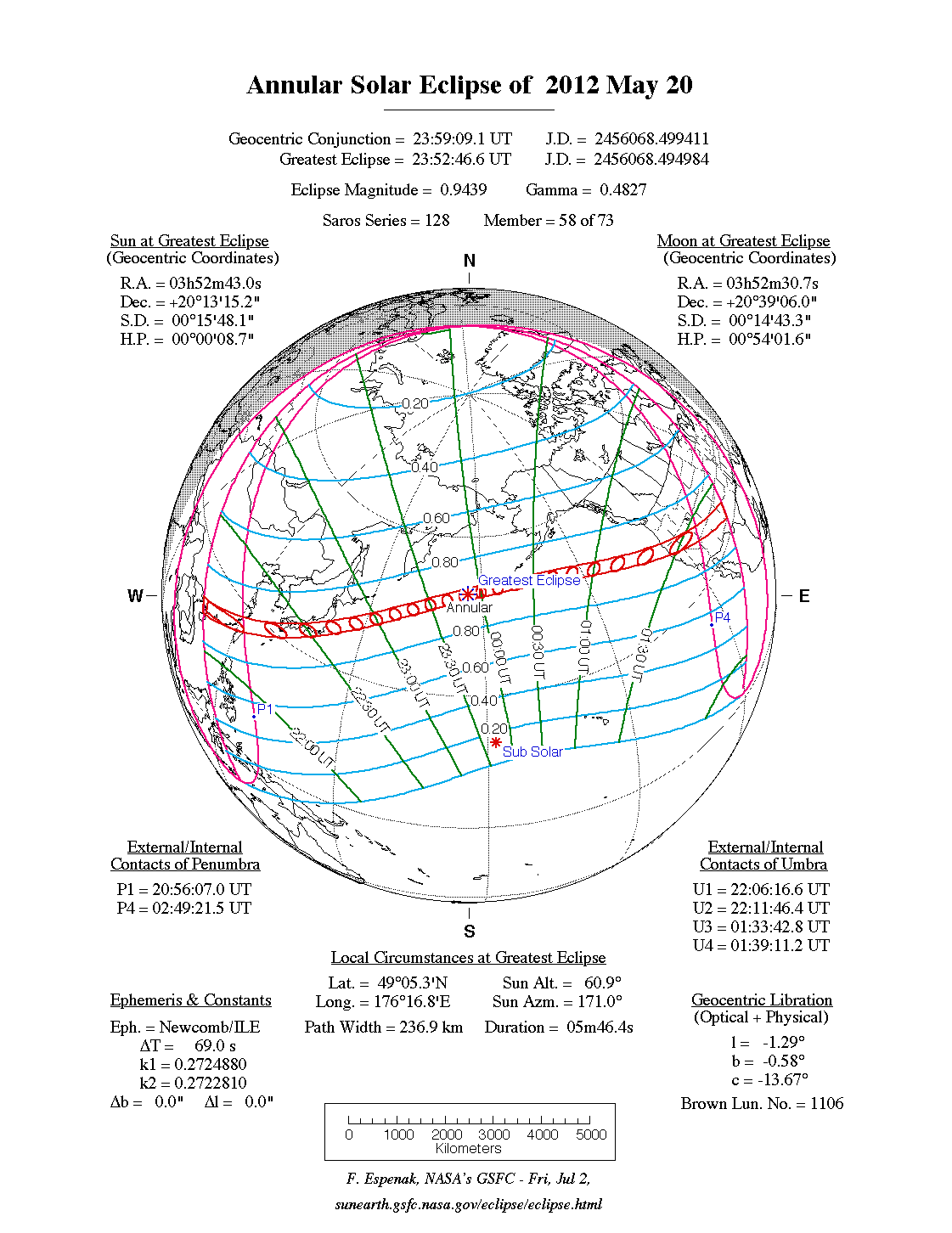
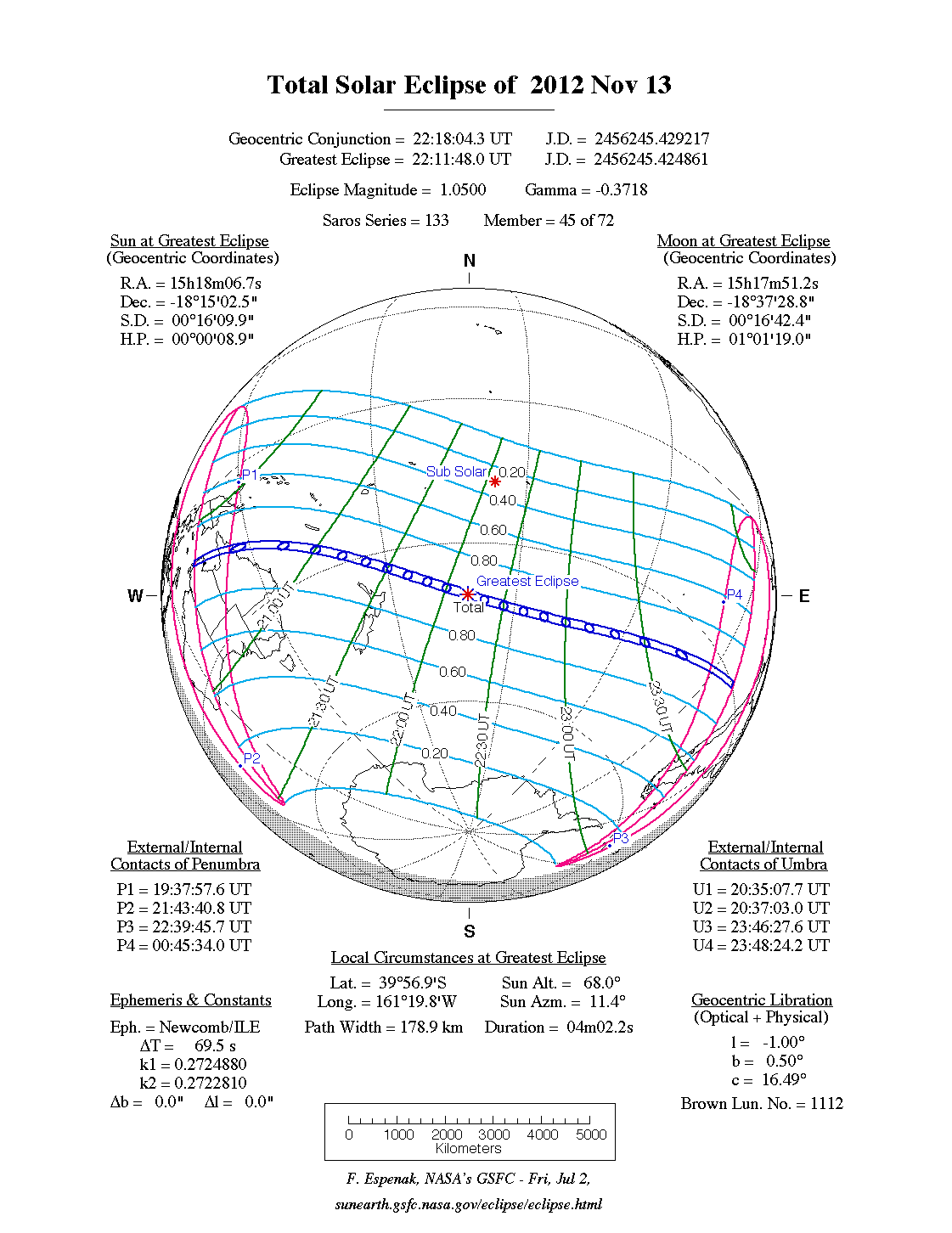
During 2012, there will be two solar eclipses and two lunar eclipses:
A full report on eclipses during 2012 will be published in Observer's Handbook 2012.

Eclipse Web Sites

The NASA Eclipse Web Site features predictions and maps for all solar and lunar eclipses throughout the 21st century, with special emphasis on upcoming eclipses. Special pages devoted to the total and annular solar eclipses of 2012 will feature detailed maps, tables, graphs, and meteorological data. A world atlas of solar eclipses provides maps of all central eclipse paths from 2000 BCE to 3000 CE. The entire Five Millennium Canon of Solar Eclipses (Espenak and Meeus, 2006) and Five Millennium Canon of Lunar Eclipses (Espenak and Meeus, 2009a) can be downloaded in PDF format and all figures are also available online as individual GIFs. On-line versions of the entire Five Millennium Catalog of Solar Eclipses (Espenak and Meeus, 2009c) and Five Millennium Catalog of Lunar Eclipses (Espenak and Meeus, 2009b) list details for every solar and lunar eclipse over the same 5000-year period. The NASA Eclipse Web Site is located at:
Detailed information on solar and lunar eclipse photography, and tips on eclipse observing and eye safety may be found at:

Acknowledgments

All eclipse predictions were generated on an Apple G4 iMac computer using algorithms developed from the Explanatory Supplement [1974] with additional algorithms from Meeus, Grosjean, and Vanderleen [1966]. The solar coordinates used in the eclipse predictions are based on VSOP87 [P. Bretagnon and G. Francou, 1988]. The lunar coordinates are based on ELP-2000/82 [M. Chapront-Touzé and J. Chapront, 1983]. For lunar eclipses, the diameter of the umbral and penumbral shadows were calculated using Danjon's rule of enlarging Earth's radius by 1/85 to compensate for the opacity of the terrestrial atmosphere; corrections for the effects of oblateness have also been included. Text and table composition was done on a Macintosh using Microsoft Word. Additional figure annotation was performed with Claris MacDraw Pro.
All calculations, diagrams, tables, and opinions presented in this paper are those of the author, and he assumes full responsibility for their accuracy.

Footnotes

[1] Eclipse magnitude for solar eclipses is defined as the fraction of the Sun's diameter occulted by the Moon.
[2] The instant of greatest eclipse for solar eclipses occurs when the distance between the Moon's shadow axis and Earth's geocentre reaches a minimum.
[3] Eclipse obscuration is defined as the fraction of the Sun's area occulted by the Moon.
[4] The Saros is a period of 6,585.3 days (18 years 11 days 8 hours) in which eclipses (both solar and lunar) repeat. The geometry isn't exact but close enough for a Saros series to last 12 or more centuries.
[5] The instant of greatest eclipse for lunar eclipses occurs when the distance between the Moon's shadow axis and Earth's geocentre reaches a minimum.
[6] Umbral eclipse magnitude is defined as the fraction of the Moon's diameter occulted by the umbral shadow.

References

Bretagnon P., Francou G., "Planetary Theories in rectangular and spherical variables: VSOP87 solution", Astron. and Astrophys., vol. 202, no. 309 (1988).
Chapront-Touzé, M and Chapront, J., "The Lunar Ephemeris ELP 2000," Astron. and Astrophys., vol. 124, no. 1, pp 50-62 (1983).
Chauvenet, W., Manual of Spherical and Practical Astronomy, Vol.1, 1891 (Dover edition 1961).
Danjon, A., "Les éclipses de Lune par la pénombre en 1951," L'Astronomie, 65, 51-53 (Feb. 1951).
Espenak, F., Fifty Year Canon of Solar Eclipses: 1986–2035, Sky Publishing Corp., Cambridge, MA, 1988.
Espenak, F., Fifty Year Canon of Lunar Eclipses: 1986–2035, Sky Publishing Corp., Cambridge, MA, 1989.
Espenak, F., and Meeus, J., Five Millennium Canon of Solar Eclipses: –1999 to +3000 (2000 BCE to 3000 CE), NASA TP–2006-214141, Goddard Space Flight Center, Greenbelt, MD, 2006.
Espenak, F., and Meeus, J., Five Millennium Canon of Lunar Eclipses: –1999 to +3000 (2000 BCE to 3000 CE), NASA TP–2009-214172, Goddard Space Flight Center, Greenbelt, MD, 2009.
Espenak, F., and Meeus, J., Five Millennium Catalog of Lunar Eclipses: –1999 to +3000 (2000 BCE to 3000 CE), NASA TP–2009-214173, Goddard Space Flight Center, Greenbelt, MD, 2009.
Espenak, F., and Meeus, J., Five Millennium Catalog of Solar Eclipses: –1999 to +3000 (2000 BCE to 3000 CE), NASA TP–2009-214174, Goddard Space Flight Center, Greenbelt, MD, 2009.
Explanatory Supplement to the Astronomical Ephemeris and the American Ephemeris and Nautical Almanac, Her Majesty's Nautical Almanac Office, London, 1974.
Littmann, M., Espenak, F., & Willcox, K., Totality—Eclipses of the Sun, 3rd Ed., Oxford University Press, New York, 2008.
Meeus, J., Grosjean, C.C., & Vanderleen, W., Canon of Solar Eclipses, Pergamon Press, New York, 1966.
Meeus, J. & Mucke, H., Canon of Lunar Eclipses: -2002 to +2526, Astronomisches Buro, Wien, 1979.

First Gov . com
NASA Logo - nasa.gov