Friday, March 25, 2011

EARTH-LIKE HUNTING

Profiles in Geekdom: The Hunt For Another 'Earth'

The universe is a pretty expansive matter, and it takes years of patient researching by various scientists to find even the smallest of discoveries to answer burning questions about space and galaxies. Some of the people who look at how galaxies were created are astrophysicists, such as Rob Crain.
Born in the UK, Rob studied physics at Durham University, and soon after earned his PhD in the astronomy field. He currently lives in Melbourne, Austrailia, working at the Centre for Astrophysics and Supercomputing of Swinburne University. His job has allowed him to travel all over to look into galaxy formations, as well as lecture, co-write research papers, and appear on the covers of various scientific journals. Next month, Rob travel to Hawaii to collect data from two very distant galaxies and use the world's best telescope at the Keck Observatory. That also means he'll get to fire a pretty big laser into the sky.
Rob took some time out of his busy schedule to speak to GeekTech about distant galaxies, possible near-future discoveries, and that big laser.
GeekTech: How did you get into the field of astrophysics?
Rob Crain: I did a physics degree at Durham, which has one of the largest astronomy groups in the world. I took a few elective astronomy modules and got hooked. In my final year I did a year-long project, and was lucky to get assigned a supervisor who happened to be very big in the field, and also an excellent teacher. I loved it, and decided I wanted to carry on with research, so applied for PhD positions in the UK. In the end Durham offered me a studentship working on exactly the kind of thing I wanted, so I stayed and got my PhD late in 2008.
GT: Your Pulsar profile says you are a "postdoctoral astrophysicist". What do you do currently?
RC: A "postdoc" is a short term (2-5 year) position that you take between finishing your PhD and getting a permanent "faculty" position. My main research area is the use of supercomputers to generate models of how galaxies form and evolve. In general, we have a good general impression of how galaxies form, but the fine details are still unresolved. Astronomy is a unique science, in that it's driven purely by observation rather than experimentation--you can't just build a new planet, star, black hole, galaxy or universe in a lab--so generating models with supercomputers is the closest we can get to "experimenting."
I also dabble in the more traditional astronomer's task of observing.
GT: Why did you decide to move to Melbourne?
RC: As I was finishing my PhD, I was offered my present job, which involved being able to continue a lot of the research I was doing as a graduate student, since the university here has its own very large supercomputer. Also, science funding in Australia right now is fantastic, providing lots of opportunities for research and sparking big new projects. For example the world's best radio telescope is currently under construction in the Western Australian desert (far from interference from televisions and mobile phones). Melbourne is also a fantastic city to live in, though I'll be moving back to Europe in a few months, as I have a new job in the Netherlands, similar to the one I have now.
GT: What have been the highlights of your career so far?
RC: Swinburne, where I currently work, is the only institute in the world where someone in a junior position (like I am) is even eligible to apply for observing time on the Keck telescopes -- usually you have to be an established professor. So going to Keck (and being in Hawaii) on the strength of my own science proposal last year was very rewarding. Also, late last year an image from one of my simulations was featured on the front cover of the prestigious journal Nature, which was an ambition of mine that I didn't think I'd ever achieve, let alone so early in my career.
GT: You are about to head over to Hawaii to collect data on galaxies. What does this mean you will be doing (and discovering!)? What do you personally hope to find?
RC: Over the last 15 years or so, astronomers have deduced that the early Universe (say, 10 billion years ago) was forming stars and galaxies at a rate 10 times higher than it is now. With all the financial turmoil of the GFC, there were lots of bad jokes about the Universe also being in a recession (cringe). We're trying to find out why the formation of galaxies has slowed up over the last few billion years.
This requires us to peer inside galaxies, at the small "nurseries" where stars are born, to get an idea of the physics at work. Observing these nurseries is easy to do in the local Universe--you've probably seen pictures of these from the Hubble Space Telescope--but for distant galaxies it's very hard. As you probably know, because the speed of light is not infinite, when we look at distant galaxies, we're seeing them as they were in the past. So in order to observe galaxy formation as it was several billion years ago, we need to look at really, really distant galaxies. So even with the gigantic 10-meter mirror on the Keck telescopes, it's a challenge to see the galaxies at all, let alone study their stellar nurseries, because they are so faint and so small on the sky.
In general, people are waiting for the next generation of 30-40-meter telescopes--due around 2020-2025 at a cost of about $1.5 billion--to have a hope of figuring all of this out. But occasionally the Universe lends a helping hand. One of Einstein's greatest achievements was the prediction that matter deflects light. It's a tiny, tiny effect such that on Earth you never notice it, but if you have a massive enough object, the effect can be strong. The most massive "objects" in the Universe are things called galaxy clusters -- areas where many galaxies congregate under their own gravity, and that of huge amounts of cosmic dark matter associated with the galaxies (pictured below). They have masses about 1015 times that of the Sun.
[Photo: NASA]
The yellow-ish galaxies are all relatively close together in a galaxy cluster. The strange blue arcs that appear to be rotating around the cluster are in fact images of galaxies that are far behind the cluster (so the cluster is in-between the blue galaxies and us on Earth). The cluster has "lensed" the galaxies; it's a bit like staring at something through the bottom of a wine glass. You see these arcs rather than a perfectly magnified image because, like the wine glass, the cluster is not a perfect lens. However, this lensing effect is hugely useful. Without the cluster in that image, you'd never see those blue galaxies, they'd be too small and faint.
In effect, the cluster turns your 10-meter telescope into a 30-meter telescope, for free, and you can beat the competition to a result by 10 years! The trade-off is that you have to spend a long time looking for galaxies that are aligned just right with galaxy clusters to get lensed. You also have to figure out how to 'un-do' the distorting effect of the lens, to reconstruct what the galaxy would like without the lens in the way. Anyway, the hope is that we'll collect a lot of data about the first stellar nurseries in the Universe, and figure out why they formed stars more efficiently than those we see today.
GT: Can you tell me more about the powerful laser you will get to use in Hawaii?
RC: One of the reasons the Hubble Space Telescope has been such a success is that it orbits above the Earth's atmosphere, and so its images are razor-sharp. Images taken from ground-based observatories are blurred by the distorting effect of the turbulent atmosphere. But we can partially correct for this distortion by rapidly deforming telescope mirrors to precisely counteract the atmosphere - a bit like giving the telescope a new set of glasses, hundreds of times a second. In order to know how to deform the mirror, we need to know how the atmosphere is affecting the light we receive from galaxies. To do this, we fire a laser (the same frequency used in orange street lamps) into the upper atmosphere, where it is scattered by sodium atoms. By measuring the distortion in the scattered light relative to the laser, we know what effect the atmosphere is having, and we can partially correct for it.
GT: Of all the discoveries ever made in space, which do you think has been the most significant?
RC: The first that springs to mind is Copernicus's realization that the Earth wasn't the center of the Universe, as this had profound effects both scientifically and culturally. More recently, people are often surprised to learn that it was only in the 1920s that Edwin Hubble proved there were galaxies other than the Milky Way, and that the Universe is expanding. New evidence in the last few years has surprised even the astronomers, because it suggests that the Universe's expansion from the Big Bang is speeding up rather than slowing down, hinting at new fundamental physics that we don't understand. But I think what will have the biggest effect on us in modern times will be the discovery of another planet similar to Earth. The rate of progress in planet hunting suggests that such a discovery will be made in the near future.
GT: As for the rest of your career, what do you hope you will be able to discover out there?
RC: Big discoveries are fairly few and far between, and progress is more commonly made in small steps. I think most astronomers are keen to keep making their small contribution to our knowledge of the Universe. New telescopes and ever more powerful supercomputers mean that there are always new and exciting discoveries to make if you work hard enough. Very few of us see it as a 9-5 job and are happy to work long hours, the pay off being fairly frequent travel to far-off locations to use telescopes and collaborate with international colleagues, and the opportunity to learn something about the Universe before anyone else does.
GT: If readers were hoping to get into astrophysics too, what would you advise is the best way to go?
RC: I'd advise them to speak to people in the field to gauge whether it's the right path for them, as it's a long, demanding (but rewarding) road. One of my colleagues has written an excellent guide for would-be astronomers, which I highly recommend.
You can find out more about what Rob will be doing in the next few months on his profile.

Saturday, March 12, 2011

Whether solar flares can trigger earthquakes?

American Geophysical Union, Spring Meeting 2007, abstract #IN33A-03

We present the study of 682 earthquakes of ¡Ý4.0 magnitude observed during January 1991 to January 2007 in the light of solar flares observed by GOES and SOXS missions in order to explore the possibility of any association between solar flares and earthquakes. Our investigation preliminarily shows that each earthquake under study was preceded by a solar flare of GOES importance B to X class by 10-100 hrs. However, each flare was not found followed by earthquake of magnitude ¡Ý4.0. We classified the earthquake events with respect to their magnitude and further attempted to look for their correlation with GOES importance class and delay time. We found that with the increasing importance of flares the delay in the onset of earthquake reduces. The critical X-ray intensity of the flare to be associated with earthquake is found to be ~10-6 Watts/m2. On the other hand no clear evidence could be established that higher importance flares precede high magnitude earthquakes. Our detailed study of 50 earthquakes associated with solar flares observed by SOXS mission and other wavebands revealed many interesting results such as the location of the flare on the Sun and the delay time in the earthquake and its magnitude. We propose a model explaining the charged particles accelerated during the solar flare and released in the space that undergone further acceleration by interplanetary shocks and produce the ring current in the earth's magnetosphere, which may enhance the process of tectonics plates motion abruptly at fault zones. It is further proposed that such sudden enhancement in the process of tectonic motion of plates in fault zones may increase abruptly the heat gradients on spatial (dT/dx) and temporal (dT/dt) scales responsible for earthquakes.

March 19, 2011… “SuperMoon” or “SuperHype”?

by Tammy Plotner on March 10, 2011

I mean no disrespect for those who enjoy the study of astrology. Some of the greatest astronomers of the past were also astrologers. To practice either line requires a deep understanding of our solar system, its movements and the relationship to the celestial sphere. The only thing I have difficulty swallowing is how a perfectly normal function could wreak havoc on planet Earth. Does an astrological prediction of an upcoming “Extreme SuperMoon” spell impending disaster – or is it just one more attempt to excite our natural tendencies to love a good gloom and doom story? That’s what I set about to find out…
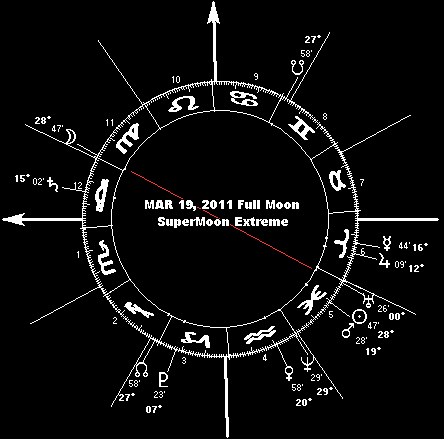
On March 19, 2011 the Moon will pass by Earth at a distance of 356,577 kilometers (221,567 miles) – the closest pass in 18 years . In my world, this is known as lunar perigee and a normal lunar perigee averaging a distance of 364,397 kilometers (226,425 miles) happens… well… like clockwork once every orbital period. According to astrologer, Richard Nolle, this month’s closer than average pass is called an Extreme SuperMoon. “SuperMoon is a word I coined in a 1979 article for Dell Publishing Company’s HOROSCOPE magazine, describing what is technically termed a perigee-syzygy; i.e. a new or full Moon (syzygy) which occurs with the Moon at or near (within 90% of) its closest approach to Earth (perigee) in a given orbit.” says Richard. “In short, Earth, Moon and Sun are all in a line, with Moon in its nearest approach to Earth.”
Opinions aside, it is a scientific fact when the Moon is at perigee there is more gravitational pull, creating higher tides or significant variations in high and low tides. In addition, the tidal effect of the Sun’s gravitational field increases the Moon’s orbital eccentricity when the orbit’s major axis is aligned with the Sun-Earth vector. Or, more specifically, when the Moon is full or new. We are all aware of Earth’s tidal bulges. The average tidal bulge closely follows the Moon in its orbit, and the Earth rotates under this tidal bulge in just over a day. However, the rotation drags the position of the tidal bulge ahead of the position directly under the Moon. It produces torque… But is it above average torque when the Moon is closer? It you ask a geologist, they’ll tell you no. If you ask an astronomer, they’ll tell you that just about any cataclysmic Earth event can be related to stars. But if you ask me, I’ll tell you that you should draw your own opinion. Even the American Meteorlogical Society states: “Tidal forces contribute to ocean currents, which moderate global temperatures by transporting heat energy toward the poles. It has been suggested that in addition to other factors, harmonic beat variations in tidal forcing may contribute to climate changes.”


Credit: Richard Nolle
“SuperMoons are noteworthy for their close association with extreme tidal forces working in what astrologers of old used to call the sublunary world: the atmosphere, crust and oceans of our home planet – including ourselves, of course. From extreme coastal tides to severe storms to powerful earthquakes and volcanic eruptions, the entire natural world surges and spasms under the sway of the SuperMoon alignment – within three days either way of the exact syzygy, as a general rule.” says Nolle. “Obviously it won’t be the case that all hell will break loose all over the world within a few days either side of the SuperMoons. For most of us, the geocosmic risk raised by SuperMoon alignments will pass with little notice in our immediate vicinity. This is a rather roomy planet, after all. But the fact remains that a SuperMoon is planetary in scale, being a special alignment of Earth, Sun and Moon. It’s likewise planetary in scope, in the sense that there’s no place on Earth not subject to the tidal force of the perigee-syzygy.”
If you take the time to really look at Nolle’s work, you’ll find that he does not believe earthquakes and volcanic eruptions go wandering all over the planet. They happen in predictable locations, like the infamous “Ring of Fire” around the Pacific plate. “If you’re in (or plan to be in) a place that’s subject to seismic upheaval during a SuperMoon stress window, it’s not hard to figure out that being prepared to the extent that you can is not a bad idea. Likewise, people on the coast should be prepared for extreme tidal surges. Severe storms on the other hand can strike just about anywhere, so it behooves us all to be ready for rough weather when a SuperMoon alignment forms.”
Does this mean I’m about to buy into astrology? Not hardly. But what I do believe in is respect for other’s work and opinions. It’s very obvious that Nolle has done his astronomy homework – as well as paying close attention to current political and social situations. “That said, there’s no harm in making sensible preparations for this year’s SuperMoons.” quips Richard. “The worst that can happen, if the worst doesn’t happen, is that you end up with a stock of fresh batteries and candles, some extra bottled water and canned goods, maybe a full tank of gas and an evacuation bag packed just in case. (The US Department of Homeland Security has a detailed evacuation kit inventory that, to quote them, “could mean the difference between life and death”.) And maybe you’ll think twice about being in transit and vulnerable to the weather hazards and delays that are so common during SuperMoon alignments. These are the kind of sensible precautions that can make a big difference if the worst does come to pass.”
What do I believe will happen during an Extreme SuperMoon? I think if we aren’t having two snowstorms followed by a nocturnal tornado and then chased down by a week of flooding in Ohio, that the March Worm Moon will appear to be about 30% brighter and about 15% larger than a “normal” full Moon. If I were an astrophotographer, I’d be getting out my camera (and hip waders) to do a few comparison shots with upcoming full Moons. But considering all things are equal?
I think I’ll just stay home.
Be sure to visit Richard Nolle’s page SuperMoon for more insight!

Friday, March 11, 2011

Distance of the moon to the earth..

On March 19, the moon will swing around Earth more closely than it has in the past 18 years, lighting up the night sky from just 221,567 miles away. On top of that, it will be full. And one astrologer believes it could inflict massive damage on the planet. When the moon goes super-extreme, chaos will ensue: Huge storms, earthquakes, volcanoes and other natural disasters can be expected to wreak havoc on Earth.

This is not a factual it's just an expeculations on the event. But it is better to be prepared.

Wednesday, March 2, 2011

Global Astronomy Month 2011

10 Ways to Get Involved

April 2011 is rapidly approaching and Astronomers Without Borders from all around the globe are busy organizing events to mark the celebration of the month dedicated to astronomy and the beauty of observing the sky. Join them in this global pursuit of sharing the Universe with everyone under the motto One People, One Sky.
If you are still wondering how to get involved, here are a few ideas:
Check the list of GAM global events and see which ones you could participate in. The pool of choices is diverse: from star parties to solar observations, from remote observing sessions to cosmic concerts, competitions and cultural events. All these events are opportunities for your local astronomy club, planetarium or public observatory to take part in an international project and attract the local community to your venue.
Create an event to go along with one of the global programs, or something of your own. Share your event with the world and those in your area looking for GAM events by registering your event on the GAM website with a short description. If it's something especially exciting or innovative let us know and we might include it on the GAM blog.
Discover the Universe from the comfort of your own home. GAM offers two ways to enjoy remote observing. Join online, live events with real-time narration. Or take control for personal observing through remotely controlled telescopes or images on demand. See Remote Observing.
If you’re a teacher, take your class to one of the events happening during Lunar Week (April 10-16)—for example, SunDay (April 7) or an evening observing session. Your students will be fascinated to discover the sky above. And be prepared to get a lot of questions from them!
Organize a night out with your family. We recommend Lyrids Watch (April 21/22), as you can get confortable and warm right in front of your porch, and spend some family time together while gazing at the sky in search of falling stars.
Instead of a night out in a club, take your friends to a different party, a Global Star Party (April 9). You will have the chance to meet Saturn and the Moon, as well as galaxies and star clusters.
Spread the word about Global Astronomy Month among your family, friends, classmates, workmates, and neighbors so that they too can wonder at the beauties of the Universe.
Stay in touch by following our website and blog. Join the conversation on Twitter by using #GAM2011, share your pictures on Flickr or become our friend on Facebook.
Write an article about GAM if you are a journalist or a blogger and inform your readers about the events taking place near them in April.
Become a sponsor of this international campaign. There are sponsorships opportunities throughout GAM2011, both for the entire month and for select, targeted programs. Download the GAM 2011 Sponsorship Package or contact AWB President Mike Simmons for more information.
Join the celebration in April 2011 as Global Astronomy Month brings together thousands of passionate individuals and hundreds of organizations worldwide to share their enthusiasm in innovative new ways, connecting people through a great sense of sharing the Universe!
####
More information:

Website: http://www.gam-awb.org/
Twitter: http://twitter.com/gam_awb
Facebook: http://www.facebook.com/gam.awb
Astronomers Without Borders
Astronomers Without Borders is dedicated to fostering understanding and goodwill across national and cultural boundaries by creating relationships through the universal appeal of astronomy. Astronomers Without Borders projects promote sharing, all through a common interest in something basic and universal—sharing the sky.For further information please contact:Mike Simmons
President, Astronomers Without Borders
Chair, GAM2011 Working Group
mike@gam-awb.org
+1 818 486 7633Thilina Heenatigala
GAM2011 Coordinator
thilina@gam-awb.org
+94 716 245 545Oana Sandu
GAM2011 Public Relations Coordinator
oana@gam-awb.org
+40 724 024 625