ECLIPSES DURING 2011
Fred Espenak
To Be Published in Observer's Handbook 2011, Royal Astronomical Society of Canada
Four partial solar and two total lunar eclipses take place in 2011. This 4:2 combination of solar and lunar eclipses in a single year is rather rare with only six cases during the 21st Century (2011, 2029, 2047, 2065, 2076 and 2094). The first and last eclipses always occur in January and December.
The dates and types of eclipses during 2011 are as follows.
Predictions for the eclipses are summarized in Figures 1, 2, 3, 4, 5, and 6. World maps show the regions of visibility for each eclipse. The lunar eclipse diagrams also include the path of the Moon through Earth's shadows. Contact times for each principal phase are tabulated along with the magnitudes and geocentric coordinates of the Sun and Moon at greatest eclipse.
All times and dates used in this publication are in Universal Time or UT. This astronomically derived time system is colloquially referred to as Greenwich Mean Time or GMT. To learn more about UT and how to convert UT to your own local time, see Time Zones and Universal Time.

Partial Solar Eclipse of January 04
The first solar eclipse of 2011 occurs at the Moon's ascending node in eastern Sagittarius. A partial eclipse will be visible from much of Europe, North Africa and central Asia (Figure 1).
The penumbral shadow first touches Earth's surface in northern Algeria at 06:40:11 UT. As the shadow travels east, Western Europe will be treated to a partial eclipse at sunrise. The eclipse magnitude [1] from European cities like Madrid (0.576), Paris (0.732), London (0.747), and Copenhagen (0.826) will give early morning risers an excellent opportunity to photograph the sunrise eclipse with interesting foreground scenery.
Greatest eclipse [2] occurs at 08:50:35 UT in northern Sweden where the eclipse in the horizon will have a magnitude of 0.858. At that time, the axis of the Moon's shadow will pass a mere 510 km above Earth's surface. Most of northern Africa, the Middle East and Central Asia also lie in the penumbra's path. The citizens of Cairo (0.551), Jerusalem (0.574), Istanbul (0.713), and Tehran (0.507) all witness a large magnitude partial eclipse.
A sunset eclipse will be visible from central Russia, Kazakhstan, Mongolia and northwest China. The partial eclipse ends when the penumbra leaves Earth at 11:00:54 UT.
Local circumstances and eclipse times for a number of cities in the penumbral path are listed in Table 1. All times are in Universal Time. The Sun's altitude and azimuth, the eclipse magnitude and eclipse obscuration [3] are all given at the instant of maximum eclipse. When the eclipse is in progress at sunrise or sunset, this information is indicated by a '-'.
The NASA JavaScript Solar Eclipse Explorer is an interactive web page that can quickly calculate the local circumstances of the eclipse from any geographic location not included in Table 1:
This is the 14th eclipse of Saros 151 [4] (Espenak and Meeus, 2006). The family begins with a series of 18 partial eclipses from 1776 to 2083. Complete details for the entire series of 72 eclipses (in the order: 18 partial, 6 annular, 1 hybrid, 39 total and 8 partial) spanning 1280 years can be found at:

Partial Solar Eclipse of June 01
The next partial solar eclipse occurs at the Moon's descending node in Taurus. The event is visible from high latitudes in the Northern Hemisphere (Figure 2).
The eclipse begins at sunrise in Siberia and northern China where the penumbral shadow first touches Earth at 19:25:18 UT. Two hours later, greatest eclipse occurs at 21:16:11 UT. At that time, an eclipse of magnitude 0.601 will be visible from the Arctic coast of western Siberia as the midnight Sun skirts the northern horizon. Although most of Alaska and northern Canada will witness the partial eclipse, the southern limit of the penumbra falls along a curve from south of Fairbanks to central New Brunswick and Nova Scotia.
Reykjavik, Iceland receives a 0.462 magnitude eclipse just before sunset. Northern most Norway, Sweden and Finland also get a midnight Sun eclipse with the event hanging above the northern horizon. The partial eclipse ends at 23:06:56 UT when the penumbra leaves Earth just north of Newfoundland in the Atlantic Ocean.
Eclipse times and local circumstances for major cities in North America, Europe and Asia are given in Table 2. The Sun's altitude, azimuth, the eclipse magnitude and obscuration are given at the instant of maximum eclipse.
This is the 68th eclipse of Saros 118. The family began with a group of 8 partial eclipses from the years 803 to 929. The Saros ends with a small partial eclipse in 2083. Complete details for the entire series of 72 eclipses (in the order: 8 partial, 40 total, 2 hybrid, 15 annular and 7 partial) spanning 1280 years can be found at:

Total Lunar Eclipse of June 15
The first lunar eclipse of 2011 occurs at the Moon's ascending node in southern Ophiuchus about 7° west of the Lagoon Nebula (M8). The Moon passes deeply through Earth's umbral shadow during this rather long event. The total phase itself lasts 100 minutes. The last eclipse to exceed this duration was in July 2000. The Moon's contact times with Earth's umbral and penumbral shadows are listed below.
Penumbral Eclipse Begins:  17:24:34 UT
   Partial Eclipse Begins:    18:22:56 UT
   Total Eclipse Begins:      19:22:30 UT
   Greatest Eclipse:          20:12:37 UT
   Total Eclipse Ends:        21:02:42 UT
   Partial Eclipse Ends:      22:02:15 UT
   Penumbral Eclipse Ends:    23:00:45 UT
At the instant of greatest eclipse [5] the umbral eclipse magnitude [6] will reach 1.6998 as the Moon's centre passes within 5.3 arc-minutes of the shadow axis. The Moon's southern limb will lay 54.2 arc-minutes from the edge of the umbra while the northern limb will lay 22.3 arc-minutes from the umbra's edge. Thus, the northern regions of the Moon will probably appear brighter than the southern regions that lie deeper in the shadow. Since the Moon samples a large range of umbral depths during totality, its appearance will change dramatically with time. It is difficult to predict the exact brightness distribution in the umbra so observers are encouraged to estimate the Danjon value at different times during totality (see Danjon Scale of Lunar Eclipse Brightness). Note that it may also be necessary to assign different Danjon values to different portions of the Moon (i.e. - north vs. south).
Nearly 30 years ago (1982 Jul 06), the author watched another total lunar eclipse with the Moon in the same part of the sky. I was amazed at how brilliantly the summer Milky Way glowed since it was all but invisible during the partial phases. Observers will have a similar opportunity during June's eclipse. In this case, the totally eclipsed Moon will lie in southern Ophiuchus just 8° northwest of the brightest Sagittarian star clouds. The summer constellations are well placed for viewing so a number of bright stars can be used for magnitude comparisons with the totally eclipsed Moon.
Antares (mv = +0.92v) is 15° to the west, Shaula (mv = +1.63) is 14° south, Epsilon Sgr (mv = +1.85) is 15° southeast, Arcturus (mv = -0.05) stands 55° to the northwest, and Altair (mv = +0.77) is 46° northeast of the Moon.
Figure 3 shows the path of the Moon through the penumbra and umbra as well as a map of Earth showing the regions of eclipse visibility. The entire event will be seen from the eastern half of Africa, the Middle East, central Asia and western Australia. Observers throughout Europe will miss the early stages of the eclipse because they occur before moonrise. Fortunately, totality will be seen throughout the continent except for northern Scotland and northern Scandinavia. Eastern Asia, eastern Australia, and New Zealand will miss the last stages of eclipse because they occur after moonset. Again, the total phase will be seen from most of these regions. Even observers in eastern Brazil, Uruguay and Argentina will witness totality. However, none of the eclipse will be visible from North America. At mid-eclipse, the Moon is near the zenith for observers from Reunion and Mauritius.
Table 3 lists predicted umbral immersion and emersion times for 20 well-defined lunar craters. The timing of craters is useful in determining the atmospheric enlargement of Earth's shadow (see Crater Timings During Lunar Eclipses).
The June 15 total lunar eclipse is the 34th member of Saros 130, a series of 71 eclipses occurring in the following order: 8 penumbral, 20 partial, 14 total, 22 partial, and 7 penumbral lunar eclipses (Espenak and Meeus, 2009a) spanning 1262 years. Complete details for Saros 130 can be found at:

Partial Solar Eclipse of July 01
Just one lunation after the previous one, the third solar eclipse of the year takes place at the Moon's descending node in western Gemini. This Southern Hemisphere event is visible from a D-shaped region in the Antarctic Ocean south of Africa (Figure 4). Such a remote and isolated path means that it may very well turn out to be the solar eclipse that nobody sees. At greatest eclipse (08:38:23 UT), the magnitude is just 0.097.
This event is the first eclipse of Saros 156. The family will produce 8 partial eclipses, followed by 52 annular eclipses and ending with 9 more partials. Complete details for the entire series of 69 eclipses spanning the years 2011 through 3237 can be found at:

Partial Solar Eclipse of November 25
The fourth and final solar eclipse of the year occurs at the Moon's ascending node in western Scorpius. The event is visible from high latitudes in the Southern Hemisphere and includes southern South Africa, Antarctica, Tasmania and most of New Zealand (Figure 5).
At the instant of greatest eclipse (06:20:17 UT) the eclipse magnitude is 0.905, making it the largest partial eclipse of the year. At that time, the lunar shadow axis will pass just 330 km above Earth's surface near the coast of Antarctica.
This is the 53rd eclipse of Saros 123. The family began with 6 partial eclipses from the years 1074 to 1164. By the time the series ends in 2318, it will have produced 70 eclipses in the following order: 6 partial, 27 annular, 3 hybrid, 14 total, and 20 partial eclipses. Complete details for Saros 123 can be found at:

Total Lunar Eclipse of December 10
The last eclipse of 2011 is a total lunar eclipse that takes place at the Moon's descending node in eastern Taurus, four days after apogee.
The Moon's orbital trajectory takes it through the southern half of Earth's umbral shadow. Although the eclipse is not central, the total phase still lasts 51 minutes. The Moon's path through Earth's shadows as well as a map illustrating worldwide visibility of the event are shown in Figure 6. The timings of the major eclipse phases are listed below.
Penumbral Eclipse Begins:   11:33:32 UT
   Partial Eclipse Begins:     12:45:42 UT
   Total Eclipse Begins:       14:06:16 UT
   Greatest Eclipse:           14:31:49 UT
   Total Eclipse Ends:         14:57:24 UT
   Partial Eclipse Ends:       16:17:58 UT
   Penumbral Eclipse Ends:     17:30:00 UT
At the instant of greatest eclipse (14:32 UT) the Moon lies at the zenith in the Pacific Ocean near Guam and the Northern Mariana Islands. The umbral eclipse magnitude peaks at 1.1061 as the Moon's centre passes 21.4 arc-minutes south of the shadow axis. The Moon's northern limb is then 6.4 arc-minutes south of the shadows axis and 33.3 arc-minutes from the umbra's edge. In contrast, the Moon's southern limb lays 36.5 arc-minutes from the shadow centre and 3.2 arc-minutes from the southern edge of the umbra. Thus, the northern half of the Moon will appear much darker than the southern half because it lies deeper in the umbra.
Since the Moon samples a large range of umbral depths during totality, its appearance will change dramatically with time. It is difficult to predict the brightness distribution in the umbra, so observers are encouraged to estimate the Danjon value at different times during totality (see Danjon Scale of Lunar Eclipse Brightness). Note that it may also be necessary to assign different Danjon values to different portions of the Moon (i.e., north vs. south).
During totality, the winter constellations are well placed for viewing so a number of bright stars can be used for magnitude comparisons. Aldebaran (mv = +0.87) is 9° to the southwest of the eclipsed Moon, while Betelgeuse (mv = +0.45) is 19° to the southeast, Pollux (mv = +1.16) is 37° east, and Capella (mv = +0.08) is 24° north.
The entire event is visible from Asia and Australia. For North Americans, the eclipse is in progress as the Moon sets with western observers favored by a larger fraction of the eclipse before moonset. Observers throughout Europe and Africa will miss the early eclipse phases because they occur before moonrise. None of the eclipse can be seen from South America or Antarctica. The NASAJavaScript Lunar Eclipse Explorer is an interactive web page that can quickly calculate the altitude of the Moon during each phase of the eclipse from any geographic location:
Table 6 lists predicted umbral immersion and emersion times for 20 well-defined lunar craters. The timing of craters is useful in determining the atmospheric enlargement of Earth's shadow (see Crater Timings During Lunar Eclipses).
The December 10 total lunar eclipse is the 23rd member of Saros 135, a series of 71 eclipses occurring in the following order: 9 penumbral, 10 partial, 23 total, 7 partial, and 22 penumbral lunar eclipses. Complete details for Saros 135 can be found at:
Explanatory Information
Solar Eclipse Figures
Lunar Eclipse Figures
Shadow Diameters and Lunar Eclipses
Danjon Scale of Lunar Eclipse Brightness
Crater Timings During Lunar Eclipses
Eclipse Altitudes and Azimuths
The altitude a and azimuth A of the Sun or Moon during an eclipse depend on the time and the observer's geographic coordinates. They are calculated as follows:
h = 15 (GST + UT - α ) + λ
a = arcsin [sin δ sin φ + cos δ cos h cos φ]
A = arctan [-(cos δ sin h)/(sin δ cos φ - cos δ cos h sin φ)]

where

h = hour angle of Sun or Moon
a = altitude
A = azimuth
GST = Greenwich Sidereal Time at 0:00 UT
UT = Universal Time
α = right ascension of Sun or Moon
δ = declination of Sun or Moon
λ = observer's longitude (east +, west -)
φ = observer's latitude (north +, south -)
During the eclipses of 2011, the values for GST and the geocentric Right Ascension and Declination of the Sun or the Moon (at greatest eclipse) are as follows:
Eclipse             Date          GST         α         δ

Partial Solar  2011 Jan 04   6.884 18.987  -22.739
Partial Solar  2011 Jun 01 16.609   4.631   22.096
Total Lunar   2011 Jun 15 17.584 17.592  -23.231
Partial Solar  2011 Jul 01 18.580   6.667   23.118
Partial Solar  2011 Nov 25   4.239 16.037  -20.682
Total Lunar   2011 Dec 10   5.265   5.143   22.554
Two web based tools that can also be used to calculate the local circumstances for all solar and lunar eclipses visible from any location. They are the Javascript Solar Eclipse Explorer and the Javascript Lunar Eclipse Explorer. The URLs for these tools are:
Javascript Solar Eclipse Explorer: eclipse.gsfc.nasa.gov/JSEX/JSEX-index.html
Javascript Lunar Eclipse Explorer: eclipse.gsfc.nasa.gov/JLEX/JLEX-index.html
Eclipses During 2012
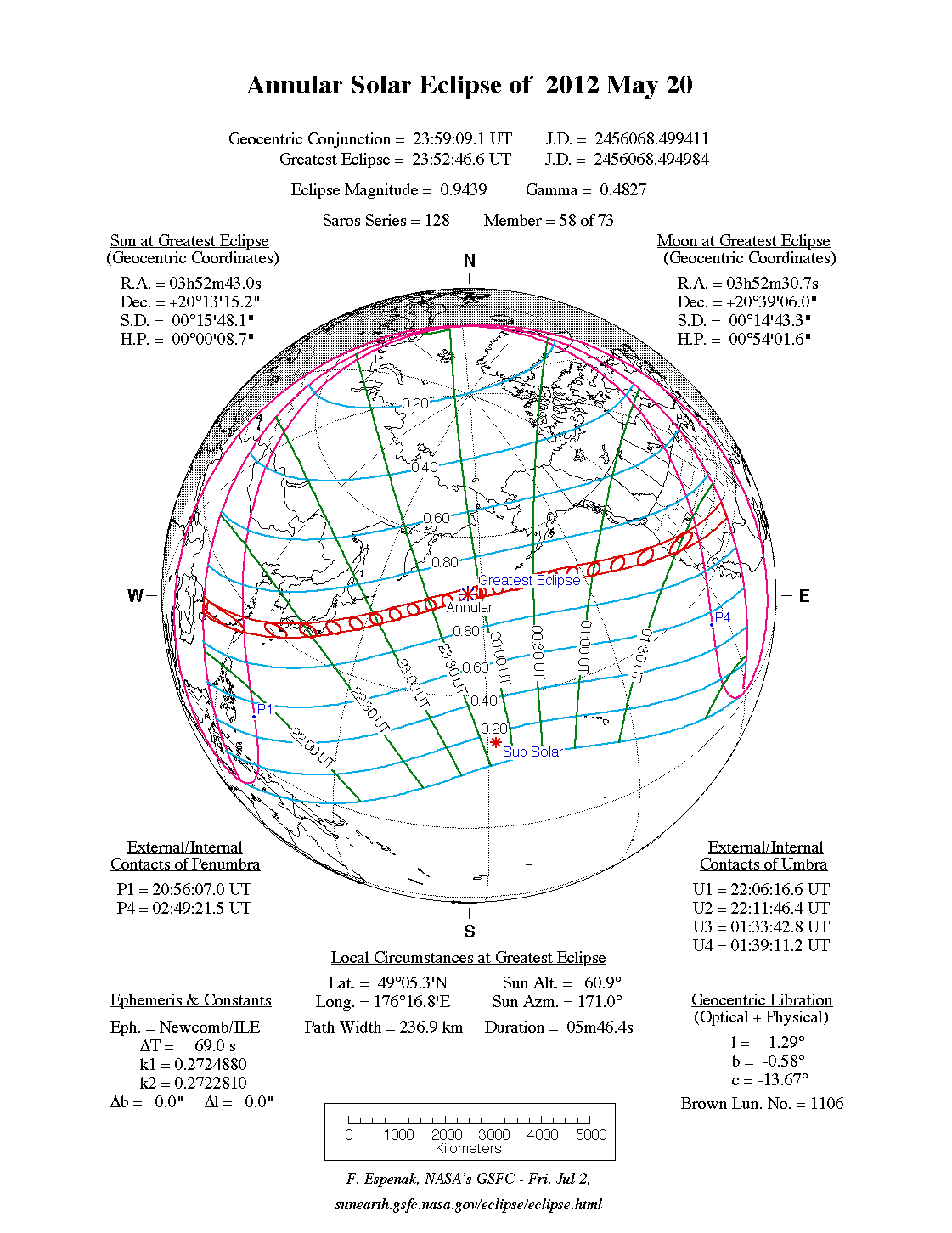
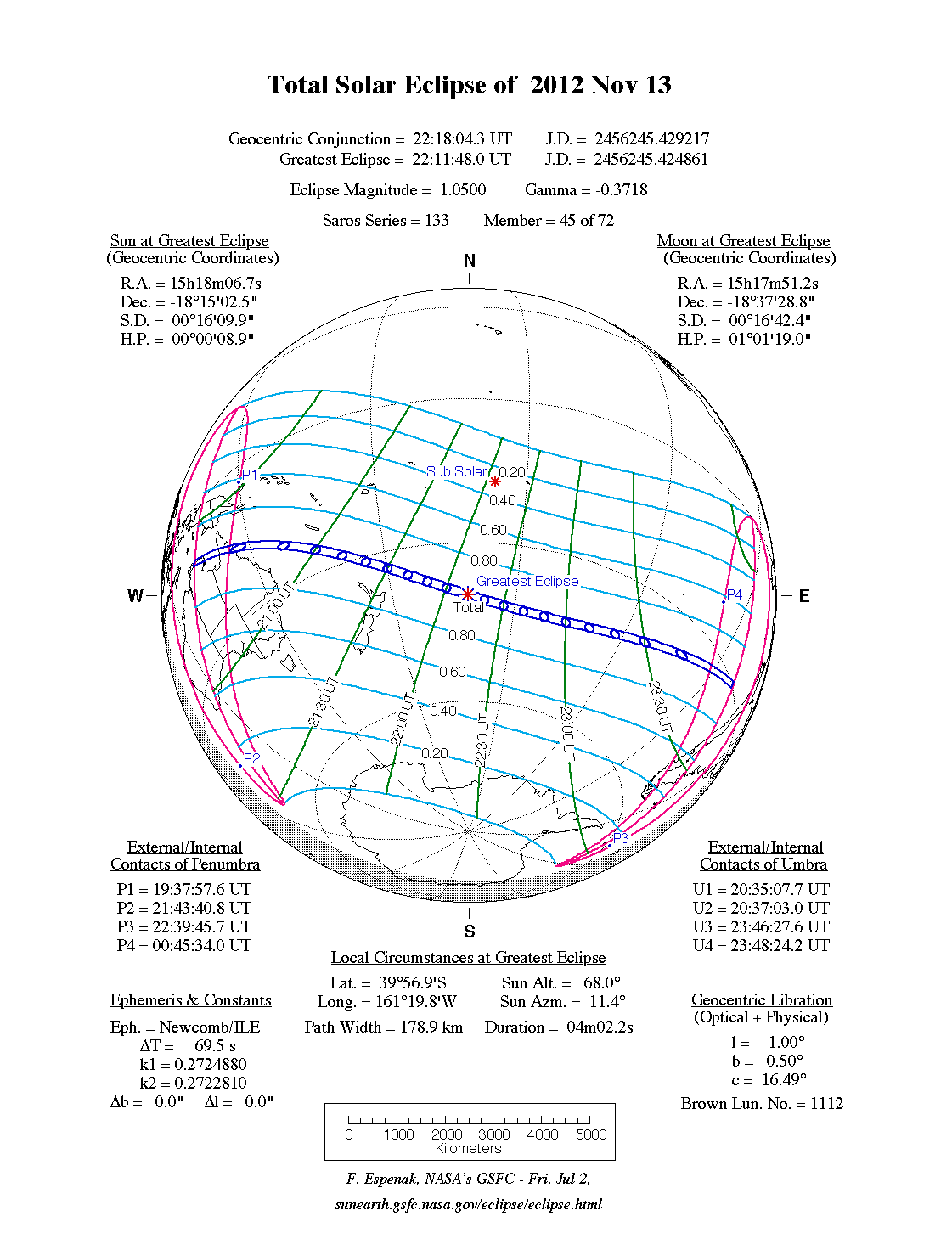
During 2012, there will be two solar eclipses and two lunar eclipses:
- 2012 May 20: Annular Solar Eclipse
- 2012 Jun 04: Partial Lunar Eclipse
- 2012 Nov 13: Total Solar Eclipse
- 2012 Nov 28: Penumbral Lunar Eclipse
A full report on eclipses during 2012 will be published in Observer's Handbook 2012.
Eclipse Web Sites
The NASA Eclipse Web Site features predictions and maps for all solar and lunar eclipses throughout the 21st century, with special emphasis on upcoming eclipses. Special pages devoted to the total and annular solar eclipses of 2012 will feature detailed maps, tables, graphs, and meteorological data. A world atlas of solar eclipses provides maps of all central eclipse paths from 2000 BCE to 3000 CE. The entire Five Millennium Canon of Solar Eclipses (Espenak and Meeus, 2006) and Five Millennium Canon of Lunar Eclipses (Espenak and Meeus, 2009a) can be downloaded in PDF format and all figures are also available online as individual GIFs. On-line versions of the entire Five Millennium Catalog of Solar Eclipses (Espenak and Meeus, 2009c) and Five Millennium Catalog of Lunar Eclipses (Espenak and Meeus, 2009b) list details for every solar and lunar eclipse over the same 5000-year period. The NASA Eclipse Web Site is located at:
Detailed information on solar and lunar eclipse photography, and tips on eclipse observing and eye safety may be found at:
Acknowledgments
All eclipse predictions were generated on an Apple G4 iMac computer using algorithms developed from the Explanatory Supplement [1974] with additional algorithms from Meeus, Grosjean, and Vanderleen [1966]. The solar coordinates used in the eclipse predictions are based on VSOP87 [P. Bretagnon and G. Francou, 1988]. The lunar coordinates are based on ELP-2000/82 [M. Chapront-Touzé and J. Chapront, 1983]. For lunar eclipses, the diameter of the umbral and penumbral shadows were calculated using Danjon's rule of enlarging Earth's radius by 1/85 to compensate for the opacity of the terrestrial atmosphere; corrections for the effects of oblateness have also been included. Text and table composition was done on a Macintosh using Microsoft Word. Additional figure annotation was performed with Claris MacDraw Pro.
All calculations, diagrams, tables, and opinions presented in this paper are those of the author, and he assumes full responsibility for their accuracy.
Footnotes
[1] Eclipse magnitude for solar eclipses is defined as the fraction of the Sun's diameter occulted by the Moon.
[2] The instant of greatest eclipse for solar eclipses occurs when the distance between the Moon's shadow axis and Earth's geocentre reaches a minimum.
[3] Eclipse obscuration is defined as the fraction of the Sun's area occulted by the Moon.
[4] The Saros is a period of 6,585.3 days (18 years 11 days 8 hours) in which eclipses (both solar and lunar) repeat. The geometry isn't exact but close enough for a Saros series to last 12 or more centuries.
[5] The instant of greatest eclipse for lunar eclipses occurs when the distance between the Moon's shadow axis and Earth's geocentre reaches a minimum.
[6] Umbral eclipse magnitude is defined as the fraction of the Moon's diameter occulted by the umbral shadow.
References
Bretagnon P., Francou G., "Planetary Theories in rectangular and spherical variables: VSOP87 solution", Astron. and Astrophys., vol. 202, no. 309 (1988).
Chapront-Touzé, M and Chapront, J., "The Lunar Ephemeris ELP 2000," Astron. and Astrophys., vol. 124, no. 1, pp 50-62 (1983).
Chauvenet, W., Manual of Spherical and Practical Astronomy, Vol.1, 1891 (Dover edition 1961).
Danjon, A., "Les éclipses de Lune par la pénombre en 1951," L'Astronomie, 65, 51-53 (Feb. 1951).
Espenak, F., Fifty Year Canon of Solar Eclipses: 1986–2035, Sky Publishing Corp., Cambridge, MA, 1988.
Espenak, F., Fifty Year Canon of Lunar Eclipses: 1986–2035, Sky Publishing Corp., Cambridge, MA, 1989.
Espenak, F., and Meeus, J., Five Millennium Canon of Solar Eclipses: –1999 to +3000 (2000 BCE to 3000 CE), NASA TP–2006-214141, Goddard Space Flight Center, Greenbelt, MD, 2006.
Espenak, F., and Meeus, J., Five Millennium Canon of Lunar Eclipses: –1999 to +3000 (2000 BCE to 3000 CE), NASA TP–2009-214172, Goddard Space Flight Center, Greenbelt, MD, 2009.
Espenak, F., and Meeus, J., Five Millennium Catalog of Lunar Eclipses: –1999 to +3000 (2000 BCE to 3000 CE), NASA TP–2009-214173, Goddard Space Flight Center, Greenbelt, MD, 2009.
Espenak, F., and Meeus, J., Five Millennium Catalog of Solar Eclipses: –1999 to +3000 (2000 BCE to 3000 CE), NASA TP–2009-214174, Goddard Space Flight Center, Greenbelt, MD, 2009.
Explanatory Supplement to the Astronomical Ephemeris and the American Ephemeris and Nautical Almanac, Her Majesty's Nautical Almanac Office, London, 1974.
Littmann, M., Espenak, F., & Willcox, K., Totality—Eclipses of the Sun, 3rd Ed., Oxford University Press, New York, 2008.
Meeus, J., Grosjean, C.C., & Vanderleen, W., Canon of Solar Eclipses, Pergamon Press, New York, 1966.
Meeus, J. & Mucke, H., Canon of Lunar Eclipses: -2002 to +2526, Astronomisches Buro, Wien, 1979.

- + Planetary Systems Laboratory – Code 693.0
NASA Goddard Space Flight Center
Greenbelt, MD 20771, USA - + Privacy Policy and Important Notices

- Project Manager: Fred Espenak
- Website Manager: Fred Espenak
- Responsible NASA Official: Robert Candey
- Last Updated: 2009 Aug 30